
Disclosure: This article contains affiliate links. If you buy through them, we may earn a commission at no extra cost to you. We only recommend products we believe may genuinely help. Read our full disclosure
⚡ Key takeaways
- Old money programs run quietly in the background.
- A 21-day plan: notice, replace, act.
- Week two is when old habits push back, and what to do then.
In this article
Grace had a strange problem. Her savings kept vanishing.
Every time she saved a little money, something happened to it. The car broke down. A "must-have" sale popped up. A friend needed a loan and never paid it back.
It didn't matter if she had $300 or $3,000. In a few weeks, it was gone. Back to zero. Again.
"I'm just unlucky with money," she told her sister.
Her sister was a nurse who had read a lot about habits. She said something that annoyed Grace: "It's not luck. It's a program. And programs can be rewritten."
Grace rolled her eyes. But that night, she couldn't sleep. What if her sister was right? What if something inside her was quietly pulling her back to zero, over and over?
So she tried a 21-day test. On day 9, she found something that shocked her. And on day 21, she had something she had never had before: savings that stayed.
Here is the simple plan she used to reprogram your subconscious mind for money, one week at a time.
(Some readers also use a short daily audio called Billionaire Brain Wave with this plan. More on that near the end.)
(We changed Grace's name. Her story is based on things many people go through.)
Your Two Minds and Money
Think of your mind like a ship.
Your conscious mind is the captain. It makes plans. It sets budgets. It says, "Let's save money this month."
Your subconscious mind is the crew below deck. It runs your habits, your feelings and your quick reactions. It does most of the work, and it does it on autopilot.
That is why you can plan to save on Monday and find yourself buying something on Thursday. The captain made the plan. But the crew followed the old map.
The good news? Habits can change. When you repeat a new thought or action again and again, it gets easier and more automatic. That is all "reprogramming your subconscious" means. You give the crew a new map, and practice it until they follow it.
Quick Check: Is an Old Money Program Running You?
- Does your money seem to disappear soon after you save it?
- Do you make the same money mistakes, even though you know better?
- Do you feel uneasy when you have more money than usual?
- Do you react to money with feelings before you think?
If you said yes to two or more, an old money program is probably at work. The 21-day plan below is made for exactly this.
The 21-Day Plan
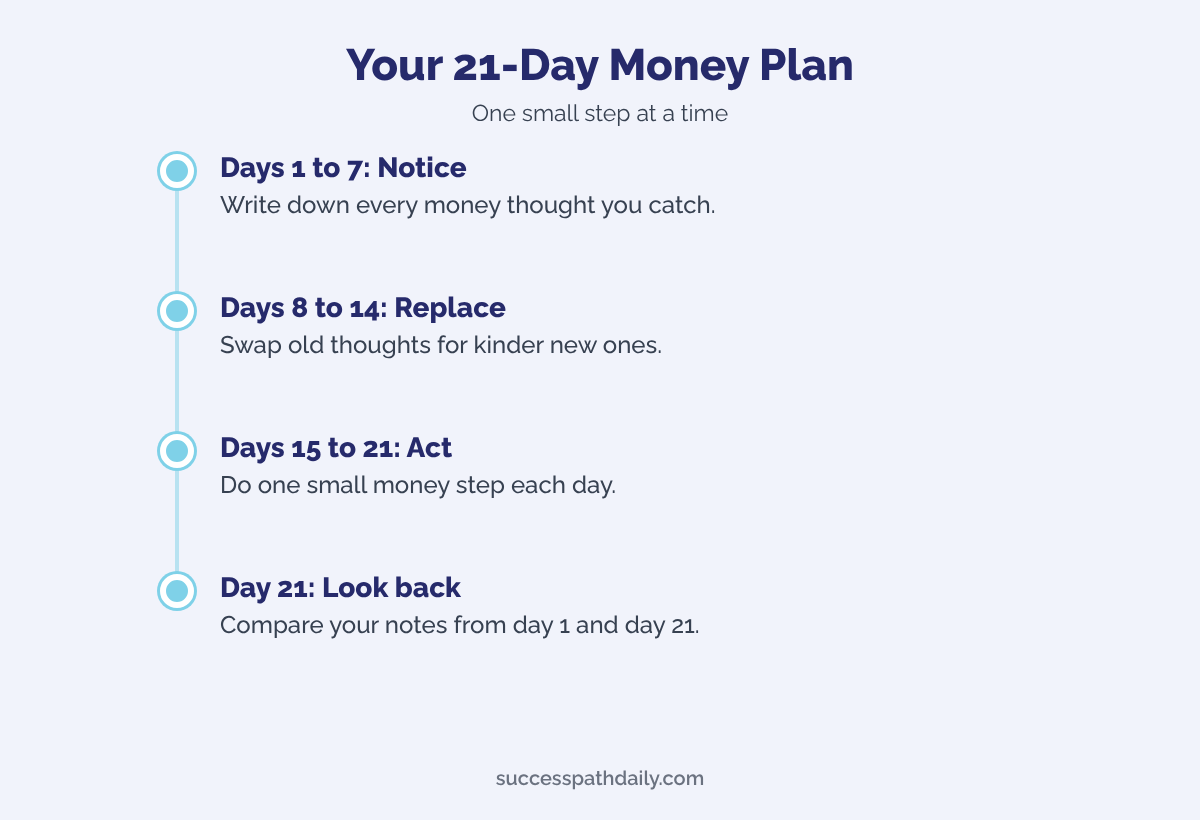
The plan has three weeks. Each week has one simple job. Don't skip ahead. Each week builds on the one before.
Days 1 to 7: Notice
This week, don't try to change anything. Just catch your money thoughts and write them down. Every worry. Every quick judgment. Use a note on your phone or a small notebook in your bag.
Grace's list shocked her. In one week, she wrote down 43 money thoughts. And 38 of them were negative. "I'll never get ahead." "Something always goes wrong." "People like me don't keep money."
Days 8 to 14: Replace
Now pick the three thoughts that show up most. For each one, write a new, kinder thought that you can believe. Not "I'm a millionaire." Something like "I'm learning to keep the money I earn."
Every time an old thought shows up, gently swap in the new one. Read your three new thoughts every morning and every night.
 You might also likeFull Moon Money Ritual for BeginnersRead it now →
Days 15 to 21: Act
This is where many people stop. And it is exactly where real change happens. Each day, do one small thing that matches your new thoughts. Move $5 into savings. Cancel one app you don't use. Wait 24 hours before buying something.
Small actions teach your subconscious that the new map is real.
Day 21: Look Back
Read your notes from day 1. Then read your notes from day 21. Most people are surprised by how different they sound.
What Grace Found on Day 9
On day 9, Grace was reading her list of money thoughts. Suddenly, she noticed a pattern.
Almost all of her worst thoughts came right after she checked her savings.
When her savings grew, she didn't feel safe. She felt nervous. Like something bad was about to happen. And when she felt nervous, she found a reason to spend.
She called her sister. "I think I spend money when I have it," she said slowly, "because having it scares me."
There it was. Grace's subconscious did not feel safe with savings. Zero felt normal. And normal felt safe. Every "unlucky" expense was really her crew steering the ship back to the place it knew.
So Grace added one new thought to her list: "It's safe for me to have money." She read it every morning. And on day 21, for the first time in years, her savings were still there.
Where Do These Money Programs Come From?
Most money programs are written long before our first paycheck.
As children, we watch how grown-ups act around money. We see them worry about bills. We hear them argue. We hear "money doesn't grow on trees" a hundred times.
Grace remembered that her mother always went quiet and tense when there was a little extra money in the house. As if she was waiting for the next emergency. Nobody ever said it out loud. But little Grace learned it anyway: having money means trouble is coming.
You don't need to blame anyone for your program. Your family did their best. But once you see where a belief came from, it loses much of its power. Try asking, "Whose voice is this money thought, really?"
The 10-Minute Daily Money Routine
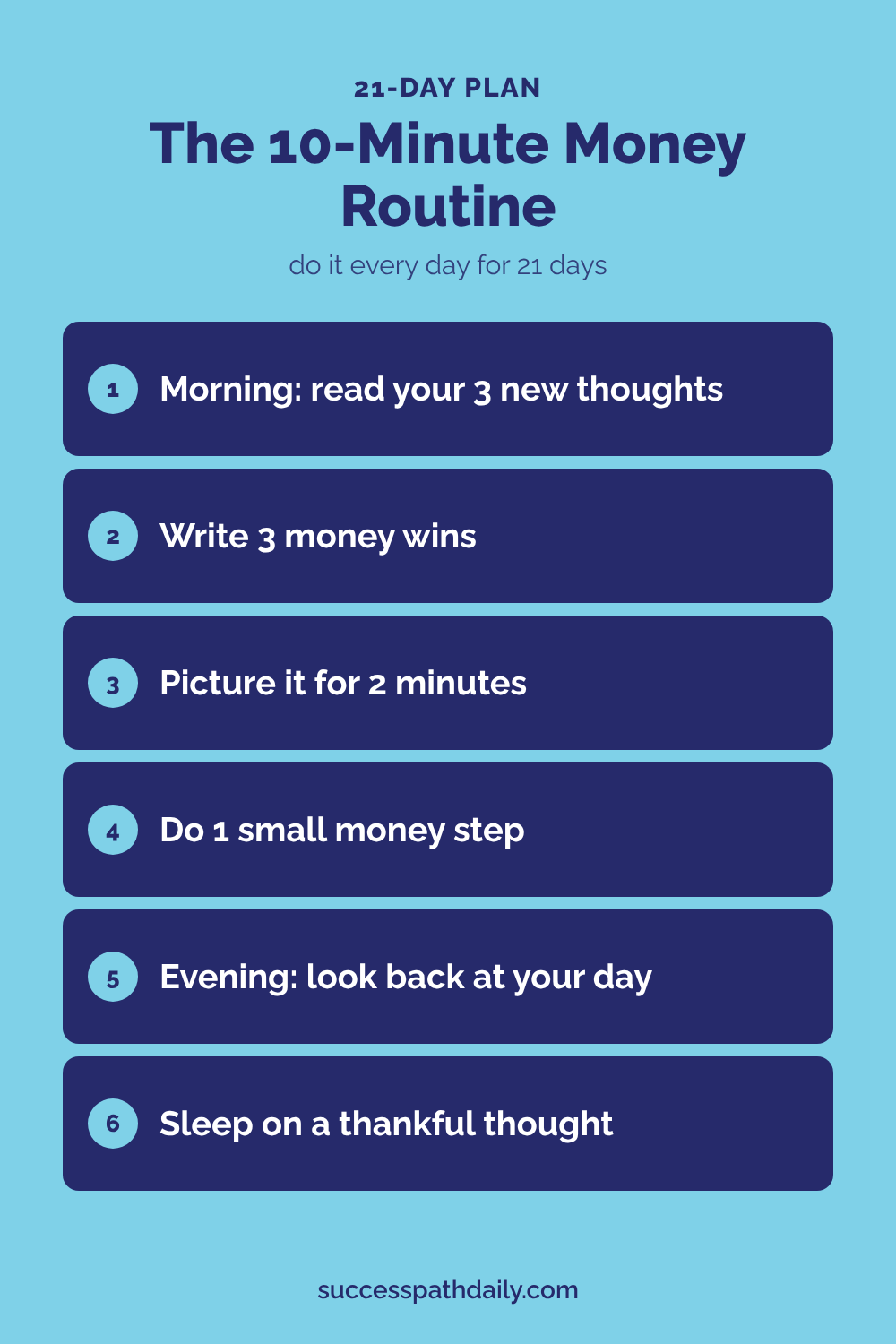
To make the 21-day plan easier, follow this routine. It takes about ten minutes a day.
- Morning: read your 3 new thoughts: slowly, out loud if you can.
- Write 3 money wins: anything good with money yesterday, even tiny things.
- Picture it for 2 minutes: see yourself handling money calmly, the way you want.
- Do 1 small money step: one action that matches your new thoughts.
- Evening: look back at your day: where did the old program show up?
- Sleep on a thankful thought: end your day thinking of one thing you are thankful for.
Why mornings and nights? Many people find their mind is most relaxed just after waking up and just before sleep. New thoughts can sink in more easily then.
Money Affirmations You Can Actually Believe
An affirmation is a short, positive sentence you say to yourself. It only helps if your mind can accept it. Here are some easy ones to start with:
- "It's safe for me to have money."
- "I'm learning to keep the money I earn."
- "Money can come to me in expected and surprising ways."
- "I make calm, wise choices with money."
- "Every small step is changing my money story."
4 Mistakes That Slow You Down
- Skipping the noticing week: you can't replace a program you haven't seen.
- Saying affirmations you don't believe: they make your mind push back. Start small.
- Only changing thoughts: without action, your subconscious doesn't fully trust the change.
- Quitting after one bad day: one slip doesn't erase your progress. Just start again the next morning.
Week Two Is When the Old Program Pushes Back
Here is something most people don't expect. Around the second week, the old program often fights back.
You may feel restless. You may think, "This is silly." You may suddenly want to go shopping. That doesn't mean you failed. It means the old pattern is being challenged.
Staying steady through this part is the hardest step. It is also the moment when many people look for a little extra help to keep going.
A Little Extra Help
If you want something simple to help you stay steady through week two, take a look at Billionaire Brain Wave. It is an audio of about seven minutes a day, made to go with a calmer, richer way of thinking.
See it for yourself and decide if it fits you. No audio can do the work for you, so keep the 21-day plan going either way.
Your Questions
Can you really reprogram your subconscious mind?
Your habits and quick reactions can change when you repeat new ones. In simple words, that is what reprogramming your subconscious means.
How long does it take to reprogram your subconscious mind for money?
Many people notice a change in about 21 days of daily practice. Deeper habits can take a few months to feel natural.
What is the best time to reprogram your subconscious mind?
Many people find just after waking up and just before sleep are the easiest times.
Do money affirmations really work?
They work best when you can believe them and when you add small actions. Big, unbelievable ones often backfire.
What are subconscious money blocks?
They are quick, automatic beliefs and feelings, often from childhood, that quietly push you away from saving or keeping money.
Give Your Mind a New Map
Grace thought she was unlucky with money. In truth, her subconscious kept steering her back to zero, because zero felt like home. Twenty-one days of noticing, replacing and acting gave her mind a new map.
Start your own 21 days tomorrow morning. Day 1 is simple. Grab a notebook and write down every money thought you catch.
You may be surprised by what you find. And even more surprised by who you are on day 21.
Affiliate link: we may earn a commission at no extra cost to you.
💬 Did this guide help you? Leave a comment below. Your comments encourage us to keep going and write more guides like this.
🎁 Your free gift: Get our free ebook library, simple guides on money, mindset and side income. Download them right now
Read Next
✨ Your turn ✨
Has this happened to you, or is something still on your mind?
Your story may help another reader who feels the same. We read and reply to every comment.
✍️ Share your storyor just tap one
💖 Thank you! Want to tell us more? Write your comment here ↓
 Next articleMoney Scripting: How to Write Your Future (With Examples)Chris wrote one page about a normal day three years from now. That page helped him make better money choices. Here is how to write your own money scriRead it now →
Get the free e-books
Join our free newsletter and get instant access to all our free e-books, plus one practical tip each week.

Join the conversation
No comments yet. Be the first to share your story or your question. We reply to every comment.
Leave a comment