
Disclosure: This article contains affiliate links. If you buy through them, we may earn a commission at no extra cost to you. We only recommend products we believe may genuinely help. Read our full disclosure
Picture two friends, Sam and Emily. On the same Monday morning, both get the same email: the promotion they wanted has gone to someone else.
Sam closes his laptop and thinks, "I knew it. I'm just not leadership material." He stops volunteering for projects. Within a year, he feels stuck and quietly resentful.
Emily feels the same sting. But after a day of disappointment, she asks her manager a different question: "What would I need to show next time?" She takes on one stretch project, learns a new skill and, eighteen months later, gets an even better role.
Same setback. Same talent. Completely different outcomes. So what made the difference?
It wasn't luck or intelligence. It was a single, invisible belief running in the background of their minds. By the end of this article, you'll know exactly which belief is running in yours, and why most people who already "know" about this idea never actually change. (That part surprises almost everyone. We'll get to it.)
What Is the Difference Between a Growth Mindset and a Fixed Mindset?
The terms come from the work of Stanford psychologist Carol Dweck, who spent decades studying why some people bounce back from failure while others fall apart. Her answer was surprisingly simple. It comes down to what you believe about your abilities.
• A fixed mindset: the belief that your talents, intelligence and personality are set in stone. You either "have it" or you don't.
• A growth mindset: the belief that your abilities can be developed through effort, good strategies and help from others.
That sounds like a small difference. It isn't. When you look closely at growth mindset vs fixed mindset, you'll see that this one belief quietly shapes how you react to challenges, mistakes, criticism and other people's success. And those reactions, repeated over years, shape your career, your money and your relationships.
Here's the catch: you can't see your own mindset directly. You can only hear it, in the words you say to yourself. Which brings us to a simple test.
Which Voice Do You Hear? Fixed vs Growth Mindset Examples
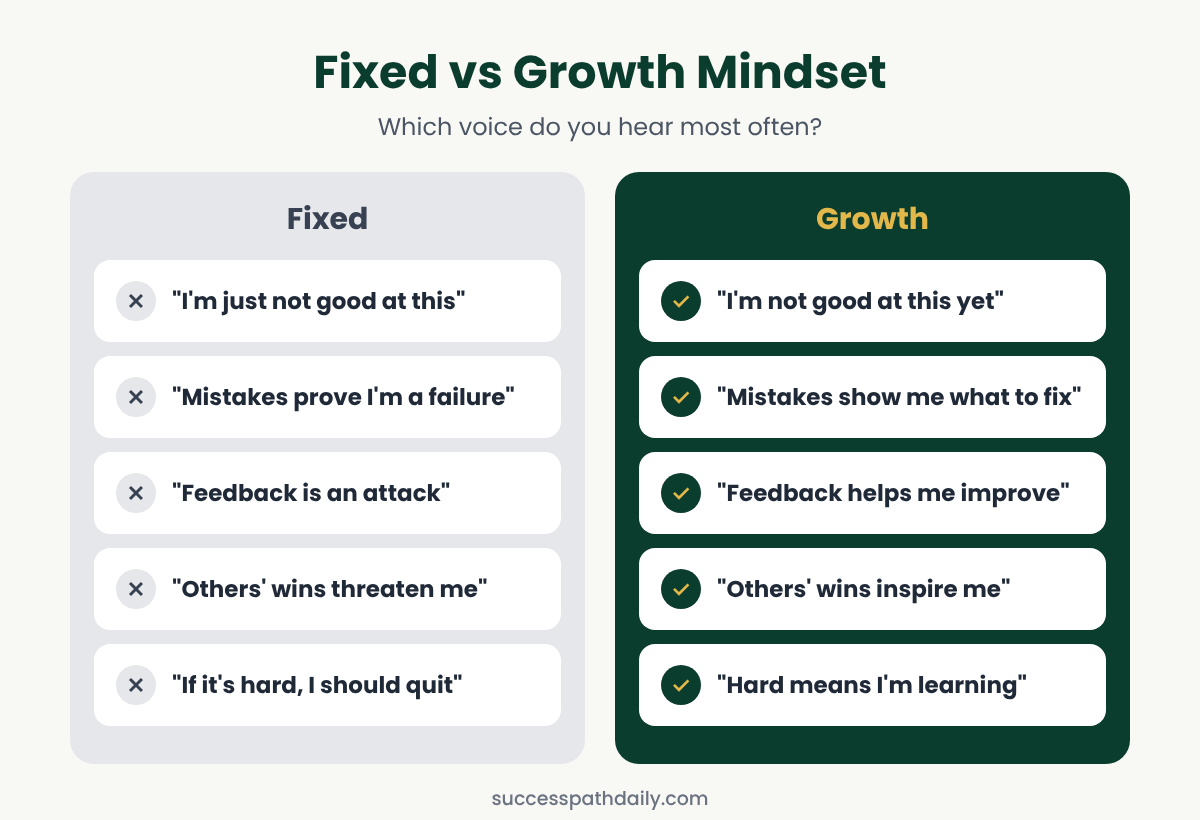
Read the pairs in the table below slowly. Be honest about which one sounds more like your inner voice on a tough day. These growth mindset examples come from five areas of everyday life.
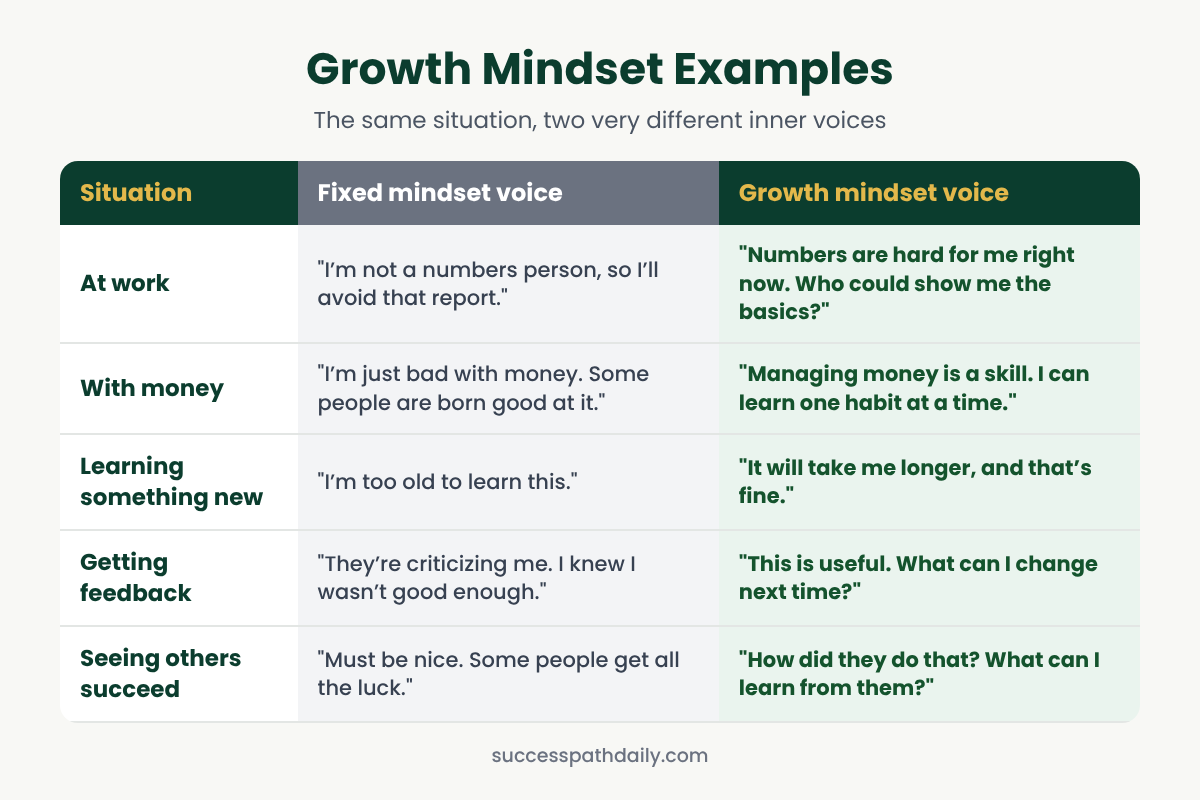
If a few of the fixed-mindset lines felt uncomfortably familiar, don't worry. That's actually good news, and here's why.
Quick Self-Check: Which Mindset Do You Have Right Now?
Answer "often" or "rarely" to each question:
1. Do you avoid tasks where you might look bad?
2. Do you feel threatened when someone else succeeds?
3. Do you give up quickly when something feels hard?
4. Do you take feedback personally?
5. Do you think "I'm just not a ___ person" (math, sports, money, people)?
6. Do you hide your mistakes rather than learn from them?
7. Do you believe effort is only for people without natural talent?
If you answered "often" to three or more, you have strong fixed-mindset habits in at least some areas of life. That's completely normal. In fact, almost everyone has a mix of both mindsets, and most of us switch between them depending on the situation. You might have a growth mindset at work but a fixed mindset about money, or the other way round.
The real question isn't "Which mindset am I?" It's "Which mindset shows up when it matters most?" And this is where the surprising part comes in.
The Twist: Why Knowing About Growth Mindset Isn't Enough
Millions of people have read about growth mindset. Schools have taught it. Companies have trained their staff in it. So why are so many of us still stuck?
Because a mindset isn't an idea. It's a habit.
Larger, more recent studies have found that short, one-off mindset lessons tend to have real but often modest effects. That makes sense when you think about it. You can't read one article (even this one) and expect years of automatic thinking to disappear. Your fixed-mindset voice has had a lot of practice. It runs on autopilot, especially when you're tired, stressed or afraid.
There's another trap, too. Many people adopt what's sometimes called a "false growth mindset". They say the right words ("I love challenges!") but still panic, avoid and quit when things get hard. They praise effort in theory but secretly still believe talent is fixed.
So if knowing isn't enough, what actually works? Repetition. Small, daily practice that slowly rewires how you respond under pressure. That's exactly what the next method is built for.
How to Change a Fixed Mindset: The 5-Step SHIFT Method
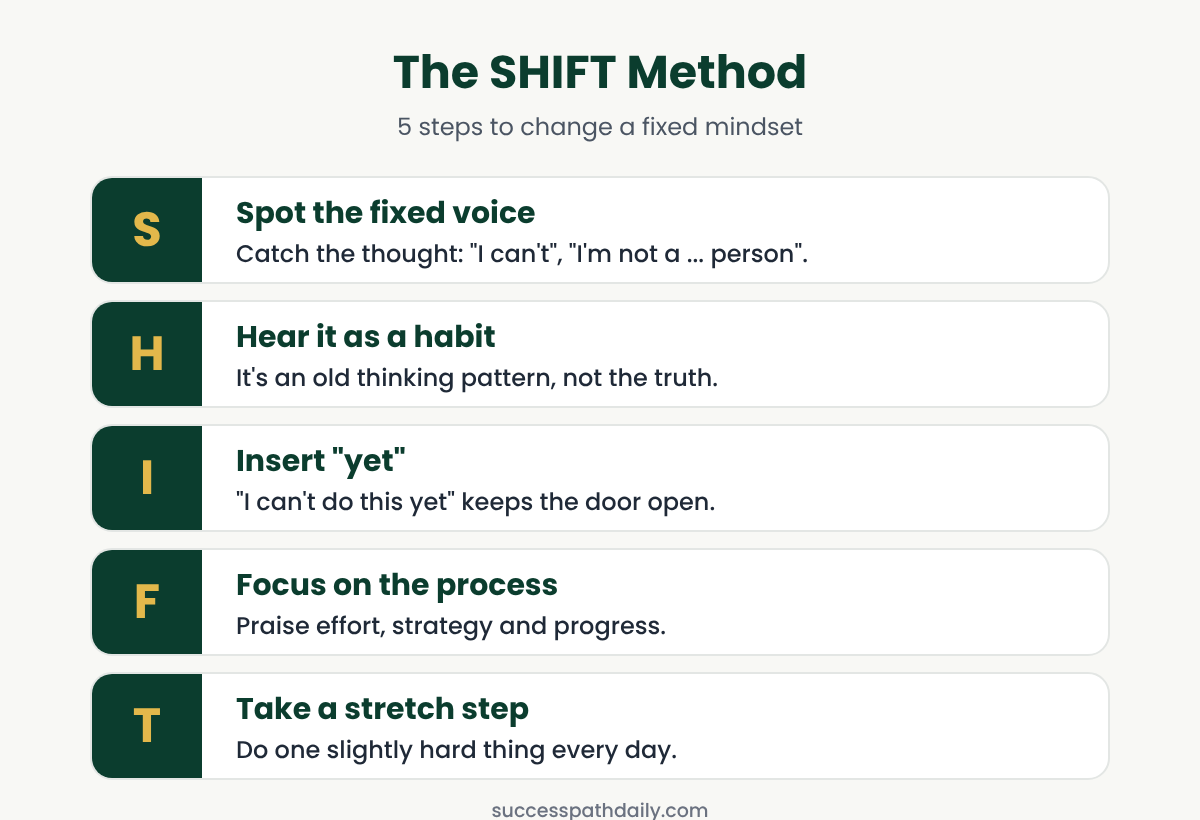
We created the SHIFT method to turn how to develop a growth mindset into something you can actually do, not just understand. Each step takes only a minute or two.
S: Spot the Fixed Voice
You can't change a thought you don't notice. For one week, listen for phrases like "I can't", "I'm not a ___ person", "What's the point?" or "They're just lucky." Each time you hear one, simply note it. Many people are shocked by how often it appears.
H: Hear It as a Habit, Not the Truth
When the fixed voice speaks, give it a name, such as "the Critic". Then remind yourself: "That's an old habit talking, not a fact." This small step creates distance between you and the thought, and distance gives you choice.
I: Insert the Word "Yet"
This is the simplest and most powerful mindset shift you can make. "I can't do this" becomes "I can't do this yet." "I don't understand investing" becomes "I don't understand investing yet." One tiny word turns a closed door into an open one.
F: Focus on the Process
Fixed-mindset thinking obsesses over results and labels: smart, stupid, success, failure. Growth thinking looks at the process: What strategy did I use? What could I try differently? At the end of each day, write down one thing you learned, not just one thing you achieved.
T: Take a Stretch Step
Every day, do one small thing that feels slightly hard. Ask a question in a meeting. Read one page about a topic you find confusing. Have a conversation you've been avoiding. Each stretch step is proof to your brain that difficulty is survivable, and that's how new beliefs are built.
Growth Mindset Phrases to Use Every Day
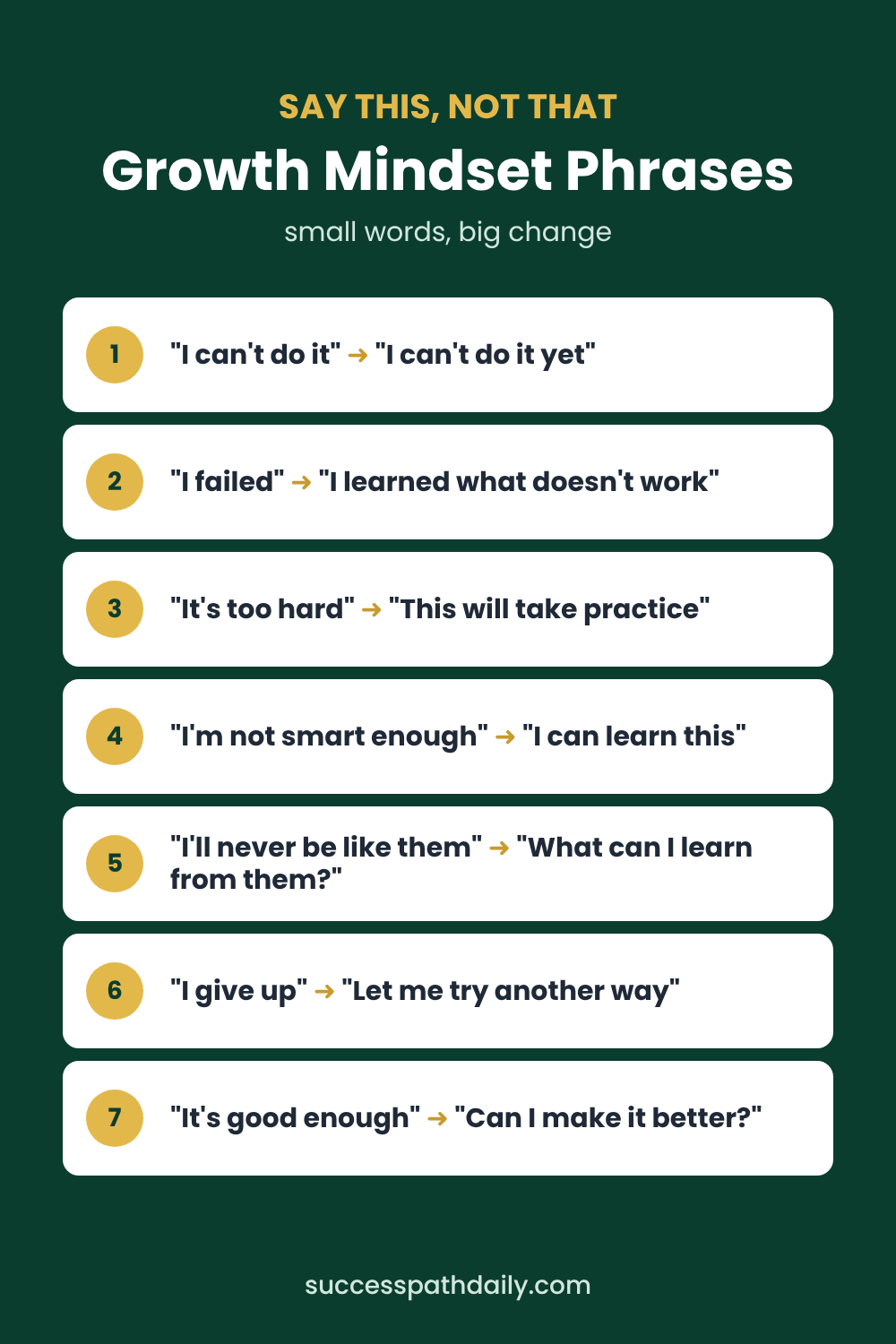
Words shape thinking. Swap these fixed-mindset phrases for their growth versions, and say the new ones out loud when you catch yourself:
• "I can't do it" becomes "I can't do it yet."
• "I failed" becomes "I learned what doesn't work."
• "It's too hard" becomes "This will take practice."
• "I'm not smart enough" becomes "I can learn this."
• "I'll never be like them" becomes "What can I learn from them?"
• "I give up" becomes "Let me try another way."
• "It's good enough" becomes "Can I make it better?"
Write your three favorites on a sticky note and put it where you'll see it every morning. It sounds simple. It is simple. That's why it works when you repeat it.
What Changes When You Shift Your Mindset?
Remember Sam and Emily? The difference between them wasn't one big decision. It was hundreds of tiny reactions over many months. When you start to practice a growth mindset, people often notice changes like these:
• Less fear of failure: mistakes start to feel like information, not judgment.
• More confidence: not because you're suddenly perfect, but because you trust yourself to learn.
• Better relationships: feedback stops feeling like an attack, so conversations become easier.
• Healthier money habits: "I'm bad with money" turns into "I'm learning to manage money," which leads to action.
• More persistence: hard things stop being a signal to quit and start being a signal that you're growing.
None of this happens overnight. But it does happen, one repeated choice at a time. The hardest part, as most people discover, is staying consistent when life gets busy.
Struggling to Stay Consistent? A Simple Daily Program That May Help
If you're like most people, you'll feel motivated for a few days, and then the old autopilot quietly returns. That's not a character flaw. It's how habits work. Many readers find it easier to keep going when they have a short, ready-made routine to follow every day, instead of relying on willpower alone.
One option in this space is Millionaire's Brain Academy (also called The Millionaire's Brain), a digital program created by Winter Vee. It's built around the idea of brain plasticity, the brain's natural ability to form new connections, which fits neatly with everything you've read about growth mindset. It also comes with a money-back guarantee, so you can try it with little risk.
According to its creators, the routine centers on short, 90-second "movie preview" style videos that you watch twice a day, plus a few simple daily habits.
At the time of writing, the official page lists these parts of the program:
• Brain Reboot: a starting module designed to help you clear old habits and make a fresh start.
• Brain Shaper: the main module for building new, success-focused thinking patterns.
• Brain Optimizer: guidance on keeping the new habits going over time.
• The Money Code: a bonus manual focused on planning your financial goals.
• The Millionaire Mindset: a bonus focused on the thoughts and beliefs that support success.
Please keep your expectations realistic. The sales page makes some big promises, but no program can rewire your brain in days or guarantee income, and results vary from person to person. We see it as an optional helper for building a daily habit, not a replacement for the practice in this guide. Check the official website for current details and the refund policy before deciding.
Frequently Asked Questions
What is the main difference between a growth mindset and a fixed mindset?
A fixed mindset believes abilities are set and can't change much. A growth mindset believes abilities can be developed through effort, good strategies and help from others. This belief shapes how people respond to challenges, mistakes and feedback.
Can a person have both a fixed and a growth mindset?
Yes. Almost everyone has a mix. You might have a growth mindset about your career but a fixed mindset about money, fitness or relationships. The goal is to notice the fixed areas and practice growth thinking there.
How long does it take to develop a growth mindset?
There's no fixed timeline. Many people notice small changes in their self-talk within a few weeks of daily practice. Deeper changes in how you react under pressure usually take months of consistent effort.
What are some examples of a growth mindset?
Saying "I can't do this yet" instead of "I can't do this," asking for feedback after a setback, learning from someone else's success instead of resenting it, and seeing hard tasks as a chance to improve.
Is a growth mindset scientifically proven?
Research shows that beliefs about ability are linked to how people approach challenges. Larger studies suggest short mindset lessons have real but modest effects, which is why ongoing daily practice matters more than simply learning the idea.
Conclusion
The gap between growth mindset vs fixed mindset isn't about who's smarter or luckier. It's about the quiet voice that speaks when things get hard, and whether that voice says "I can't" or "I can't yet."
You now know how to spot that voice, why simply knowing about growth mindset isn't enough and exactly what to do about it. Start tonight: catch one fixed thought, add the word "yet" and take one small stretch step tomorrow. Then do it again the next day.
A year from now, you could be the Emily in your own story. It starts with one shift.
Discover Millionaire's Brain Academy
Affiliate link: we may earn a commission at no extra cost to you.
Get the free ebook: The Money Mindset Shift
Join our free newsletter and get the ebook straight away, plus one practical money mindset tip each week.
Comments
No comments yet. Be the first to share your thoughts.
Leave a comment