
Disclosure: This article contains affiliate links. If you buy through them, we may earn a commission at no extra cost to you. We only recommend products we believe may genuinely help. Read our full disclosure
⚡ Key takeaways
- Tired and rushed minds make poorer decisions.
- The 5-step CLEAR framework with a real example.
- Common mistakes and tips for deciding under pressure.
- 📄 Free printable: The CLEAR Decision Worksheet
In this article
Some decisions keep you awake at night, while others quietly shape your future without you even noticing. Learning how to make better decisions is easily one of the most valuable skills you can ever build. Think about it: almost every single outcome in your life—from the state of your bank account to the quality of your relationships—starts with one single choice you decide to make.
The good news is that good decisions don't depend on luck or a special talent. They come from a clear process that anyone can learn. In this guide, you'll discover why smart people still make poor choices, and a simple five-step framework you can use for any decision, big or small.
Why Good People Make Poor Decisions
Most bad decisions aren't made by careless people. They're made by busy, tired or stressed people who don't have a method to fall back on. A few common traps get in the way:
- Decision fatigue: after a long day of small choices, your ability to weigh options carefully tends to weaken, and you're more likely to pick whatever is easiest.
- Overthinking: endlessly replaying the same options can feel productive, but it often leads to delay rather than clarity.
- Emotions in the driver's seat: fear, excitement or frustration can push you toward a quick choice you later regret.
- Too few options: many people treat a decision as "yes or no" when there are often better third or fourth choices.
A simple framework protects you from these traps. Instead of relying on how you feel in the moment, you follow the same calm steps every time.
The CLEAR Decision-Making Framework
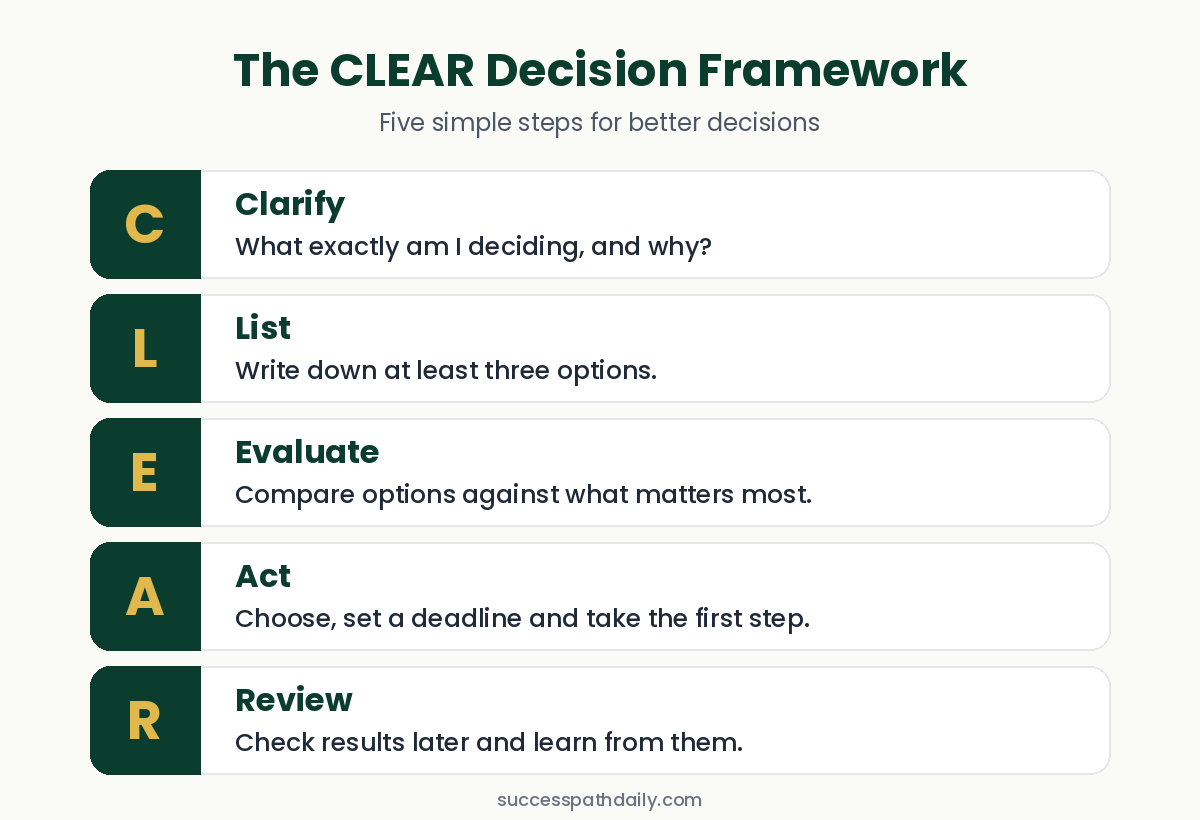
The framework below has five steps, one for each letter of the word CLEAR. It's easy to remember and works for everyday choices as well as major life decisions, like changing jobs or making a big purchase.
Step 1: Clarify the Real Decision
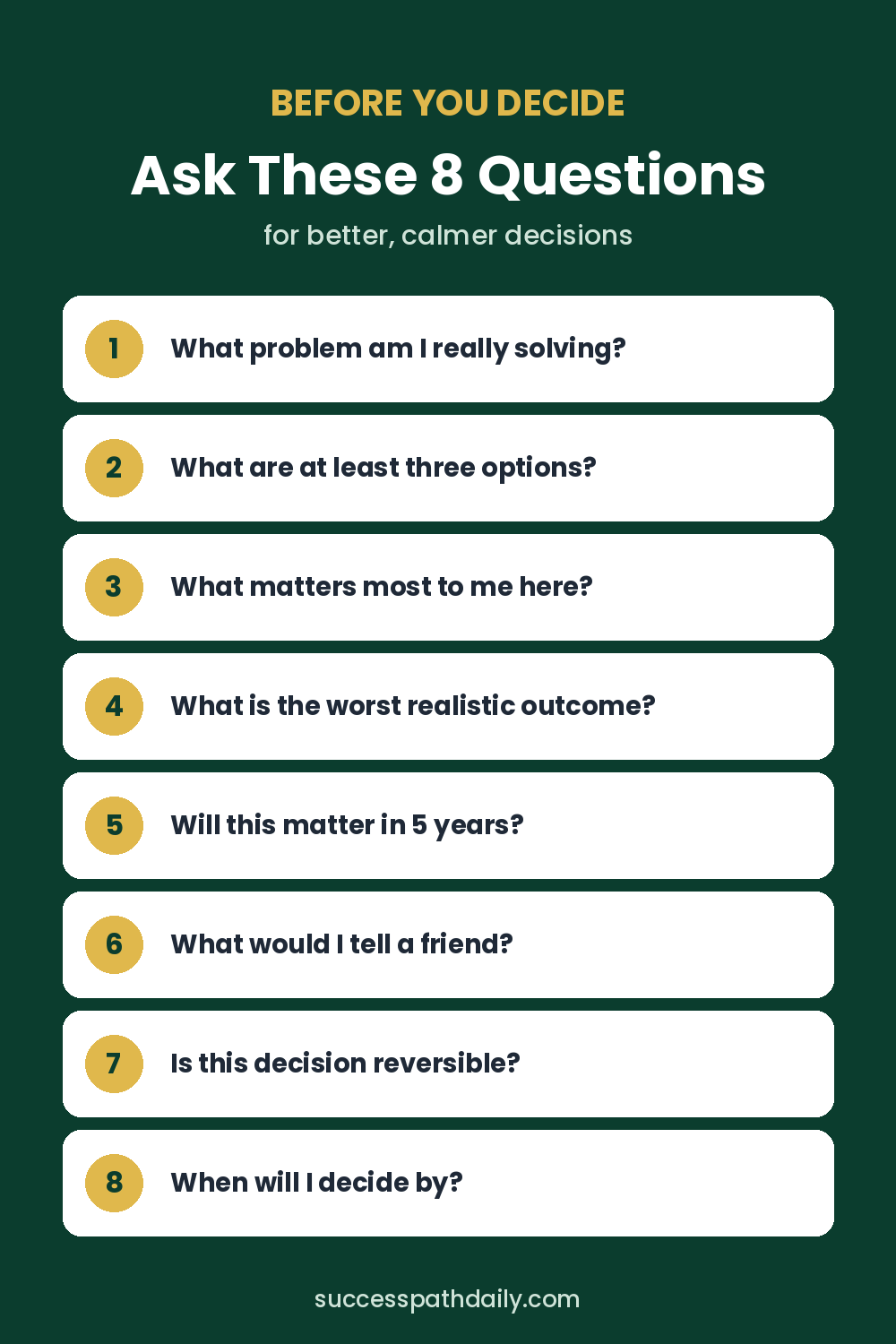
Many decisions feel hard because they're unclear. Before thinking about answers, write down the decision in one sentence. Then ask: "What problem am I really trying to solve?"
For example, "Should I quit my job?" might really be "How can I feel less stressed and earn more?" That second question opens up many more possibilities, such as asking for a raise, changing teams or building a side income.
Step 2: List at Least Three Options
Our minds love simple either-or choices, but they often hide better paths. Push yourself to list at least three options, even if one seems unusual. Include "do nothing for now" as an option, so you can compare it fairly with the alternatives.
If you're stuck, ask what someone you admire would consider, or what you would suggest to a friend in the same situation.
Step 3: Evaluate Options Against What Matters Most
This is the heart of the decision-making process. Start by naming your top three priorities for this decision, such as money, time, family or peace of mind. Then score each option from 1 to 5 against each priority.
A simple pros and cons list helps too, but scoring against your priorities is more powerful, because it reflects what you actually care about rather than which list is longer. Also ask: "What is the worst realistic outcome of each option, and could I recover from it?"
Step 4: Act With a Deadline
Information is useful, but at some point, more research simply becomes delay. Give every decision a deadline that matches its size: an hour for small choices, a day or a week for bigger ones.
 You might also likeTheta Waves: What They Are and What They Do for Your BrainRead it now →
When the deadline arrives, choose the best option based on what you know, and take one small first step the same day. Action builds confidence, and confidence makes the next decision easier.
Step 5: Review and Learn
Set a reminder to look back at important decisions after a few weeks or months. What went well? What would you do differently? This isn't about blaming yourself. It's about noticing patterns, so every decision teaches you something for the next one.
Over time, these reviews build something valuable: trust in your own judgment.
A Real-Life Example: Using the CLEAR Framework
Imagine Sarah, a teacher who has been offered a weekend tutoring job that pays well but would take up most of her Saturdays. Here's how the framework might guide her:
- Clarify: her real goal isn't just more money. It's paying off a credit card within a year without burning out.
- List: take the full tutoring job, tutor only two Saturdays a month, offer online tutoring on weekday evenings, or decline and cut expenses instead.
- Evaluate: she scores each option against her priorities: paying off debt, rest and family time. Online evening sessions score well on all three.
- Act: she gives herself until Friday, chooses online tutoring, and contacts the company the same afternoon.
- Review: after two months, she checks her progress and energy levels, and adjusts her hours if needed.
Notice that the best choice wasn't one of the two options she started with. That's the power of slowing down just enough to see the bigger picture.
Common Decision-Making Mistakes to Avoid
- Deciding to please others instead of considering what matters to you.
- Waiting for perfect information, which rarely arrives.
- Ignoring your gut completely. Intuition is useful when it's checked against facts.
- Never looking back, which means repeating the same mistakes.
Quick Tips to Beat Overthinking and Decision Fatigue
Alongside the CLEAR framework, a few simple habits can make decision making feel lighter every day:
- Make your biggest decisions early in the day, when your mind is fresh and you have the most energy.
Example: If you need to negotiate a contract renewal with a major client, schedule the meeting for 9:00 AM rather than late in the afternoon when your patience and focus are drained. - Reduce small decisions by creating routines, such as planning meals or outfits for the week.
Example: Pre-packing your lunches every Sunday afternoon eliminates the daily lunchtime debate of where to eat, saving you time and keeping your diet on track. Try the 10-10-10 rule, created by Suzy Welch, a business journalist and former editor of the Harvard Business Review: how will I feel about this in 10 minutes, 10 months and 10 years?
Example: If you are tempted to skip a late-night networking event to stay home, ask yourself: Will I care in 10 minutes? (Yes, I'll be cozy). In 10 months? (Maybe, I missed out on industry connections). In 10 years? (Probably not, but building a network matters long-term).
- Sleep on major decisions whenever you can. Giving it a night's rest almost always gives you a much calmer, clearer perspective. When you are completely stressed, or in an angry mood, or tired, your brain goes into panic mode, making you react purely on emotion. Waiting until the next morning gives your brain time to cool down and process the information so you can make a choice you won't regret.
Example: If you get into a heated disagreement with a business partner over a project, resist the urge to send an angry, immediate response. Close your laptop, go to bed, and read the email again the next morning before replying. - Separate choices you can undo from the ones you can't. Make quick calls on easily reversible decisions, and save your deep thinking for the permanent ones.
Example: Deciding whether to try a new streaming subscription is a low-stakes, reversible choice—if you don't like it, you can just cancel it next month. But deciding to quit your job to become a full-time freelancer is an irreversible choice that requires careful planning and a solid financial cushion.
How to Make Better Decisions Under Pressure
We all know that sometimes there's no time for a full framework. So, in those moments, we need to take three slow breaths, name the decision out loud, and ask just two questions: "What matters most right now?" and also another question, "Which course of action minimizes permanent risk and allows for strategic course correction?"
By condensing the CLEAR framework, you effectively mitigate emotional reactivity and bolster decisive, confident execution under strict time constraints.
Tools That May Help You Decide With Confidence
It's a lot easier to stick to a new routine when you have a solid guide or workbook to keep you on track. Using tools like personal journals, simple decision templates, or quick mini-courses can really help turn these ideas into daily habits.
One practical option is The No-Regret Decision System. The creators designed it entirely around building clarity, boosting confidence, and making better choices. It may suit anyone who constantly feels stuck, overthinks things, or just wants a straightforward, step-by-step method to follow.
Of course, just like any program, it’s a tool to help you—not a magic fix that replaces your own common sense—and everyone's experience will be a bit different. If you're interested, take a look at their official website to check out the current pricing and refund policy before you dive in.

📄 Free printable
The CLEAR Decision Worksheet
A one-page worksheet to use with this guide. Print it, fill it in and keep it where you will see it. No sign-up needed.
Download the free PDF See all printables →Frequently Asked Questions
What is the best way to make a difficult decision?
Use a simple process: clarify the real problem, list at least three options, compare them against your top priorities, set a deadline and take a first step. Following the same steps each time reduces stress and second-guessing.
How can I stop overthinking decisions?
Give each decision a deadline that matches its importance, separate reversible choices from irreversible ones, and limit how much research you do. Once the deadline arrives, choose the best option based on what you know.
What is decision fatigue?
Decision fatigue describes the way the quality of our choices can decline after making many decisions in a row. Routines, fewer small choices and deciding important things earlier in the day may help.
Is a pros and cons list enough to make a good decision?
It's a helpful start, but it treats every point as equally important. Scoring each option against your top priorities usually gives a clearer, more personal answer.
How do I know if I made the right decision?
You can't always know right away. Focus on whether you made a thoughtful decision with the information you had, then review the result later and learn from it. A good process matters more than a perfect outcome.
Conclusion
Effective decision-making is not predicated on flawless outcomes, but on the execution of a structured, objective methodology. This process requires a systematic progression: isolating the core objective, enumerating viable alternatives, assessing each option against foundational priorities, implementing a strict deadline for execution, and conducting a post-action review to extract key insights.
Integrate the CLEAR framework into a singular decision-making process this week—even a minor, low-stakes operational choice. With consistent practice, your analytical velocity will improve, shifting your resources away from speculative hesitation and toward decisive execution.
Check Out The No-Regret Decision System
Affiliate link: we may earn a commission at no extra cost to you.
✨ Your turn ✨
Has this happened to you, or is something still on your mind?
Your story may help another reader who feels the same. We read and reply to every comment.
✍️ Share your storyor just tap one
💖 Thank you! Want to tell us more? Write your comment here ↓
 Next in this seriesGrowth Mindset vs Fixed Mindset: Examples and How to ChangeTwo people face the same setback. One gives up, the other grows. The difference is mindset. Learn the signs of each, see everyday examples and use a sRead it now →
Get the free e-books
Join our free newsletter and get instant access to all our free e-books, plus one practical tip each week.


Join the conversation
No comments yet. Be the first to share your story or your question. We reply to every comment.
Leave a comment