

Disclosure: This article contains affiliate links. If you buy through them, we may earn a commission at no extra cost to you. We only recommend products we believe may genuinely help. Read our full disclosure
⚡ Key takeaways
- Most decisions can be undone, so they need less worry.
- The 3-Gate Method helps you decide faster.
- 7 quick tricks and how to stop replaying a decision.
In this article
Lauren found the perfect apartment on day two of her search. Sunny kitchen, quiet street, a ten-minute walk to work. The rent was right. She loved it the moment she walked in.
So she kept looking. Just to be sure.
Three weeks later, she had compared 14 apartments in a color-coded spreadsheet. She had read every online review of every building. She had asked her sister, her coworkers and two friends for their opinions. Finally, she called the landlord of that first apartment to say yes.
"Sorry," he said. "Someone signed the lease yesterday."
That night, Lauren couldn't sleep. Not because she lost the apartment, but because she realized she did this with everything: jobs, purchases, even what to order at dinner. A week later, her father said one sentence on the phone that changed how she makes every decision. (We'll share it in a moment.)
In this guide, you'll learn how to stop overthinking decisions with a simple method we call the 3-Gate Method, discover the 8 signs that you're an overthinker and get 7 quick tricks to decide faster, with fewer regrets.
(For readers who want a step-by-step system for the big life choices, there's also something called The No-Regret Decision System. More on that later.)
Quick Check: Are You an Overthinker?
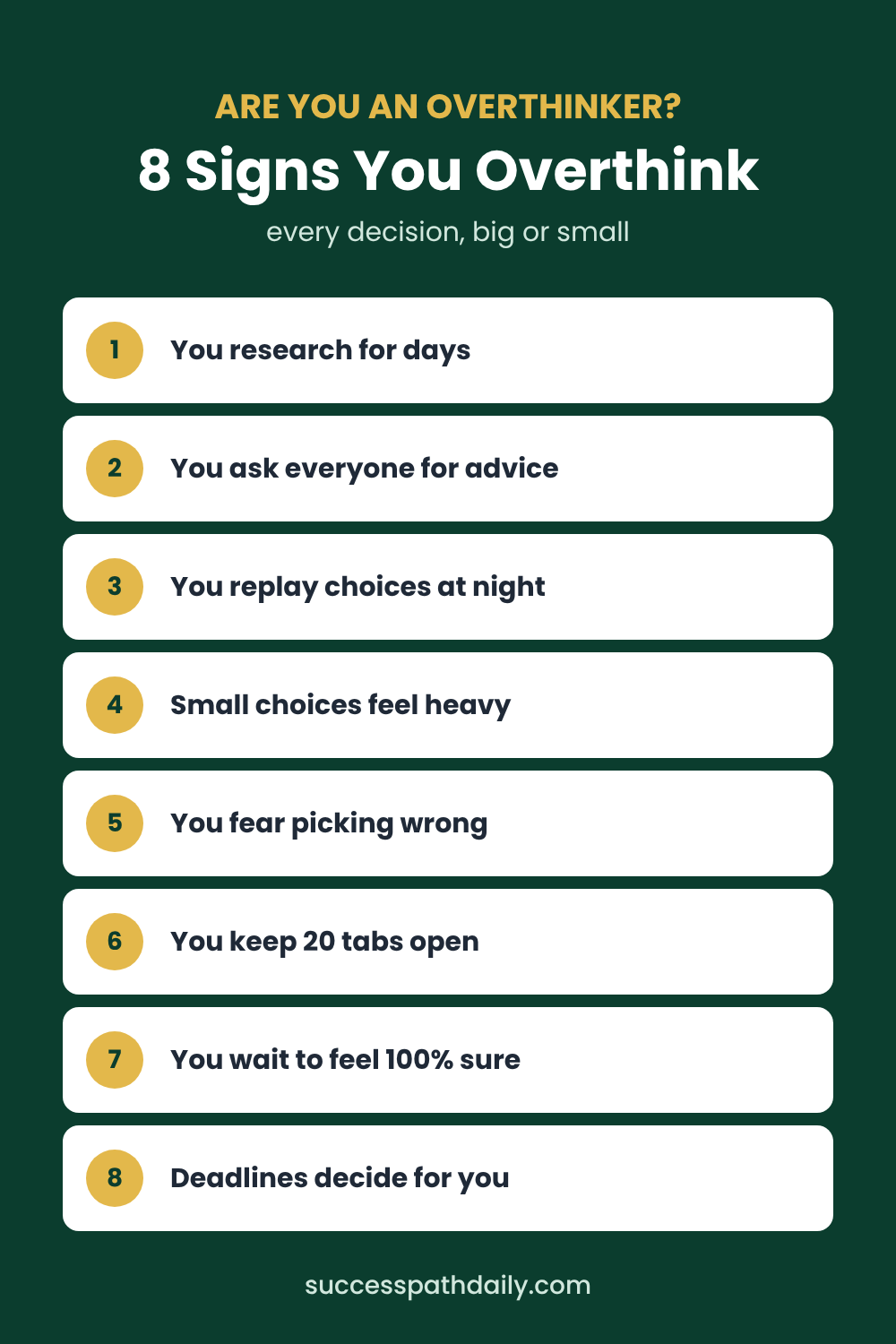
Count how many of these sound like you:
1. You research for days, even for small purchases.
2. You ask everyone for advice, then feel more confused.
3. You replay choices at night, wondering if you got it wrong.
4. Small choices feel heavy, like choosing a restaurant or a gift.
5. You fear picking wrong more than you want to pick right.
6. You keep 20 tabs open comparing options that are nearly identical.
7. You wait to feel 100% sure, and that feeling never comes.
8. Deadlines decide for you, because you never decided yourself.
0 to 2: you're a fairly decisive person. 3 to 5: overthinking is costing you time and energy. 6 to 8: you're where Lauren was, and the method below was made for you.
Why We Overthink Decisions
Overthinking isn't a sign that something is wrong with you. Often, it comes from good intentions that have gone too far:
 You might also likeThe Brain Song Review 2026: An Honest, Research-Based LookRead it now →
- Fear of regret: we imagine how bad we'll feel if we choose wrong, so we delay choosing at all.
- Too many options: researchers who study choice have found that more options can leave people less satisfied, not more.
- Perfectionism: we look for the "perfect" choice when a good one would do.
- Decision fatigue: after a long day of small choices, even simple decisions feel exhausting.
Here's the uncomfortable part: overthinking feels like being careful. But Lauren wasn't being careful. She was being afraid, and calling it research.
The Sentence That Changed Everything
When Lauren told her father about the apartment, he listened, then said: "Most of your decisions are doors that swing both ways. Stop treating them like they lock behind you."
That's the twist. Most decisions are reversible. You can return the blender, change the paint color, leave the gym or even move out of an apartment after a year. Only a few choices truly lock behind you. Yet overthinkers treat every door as if it's permanent, so every choice feels huge.
Once Lauren started asking "Can I undo this?", most of her decisions shrank instantly. And that question became the first gate of the method below.
The 3-Gate Method: How to Stop Overthinking Decisions
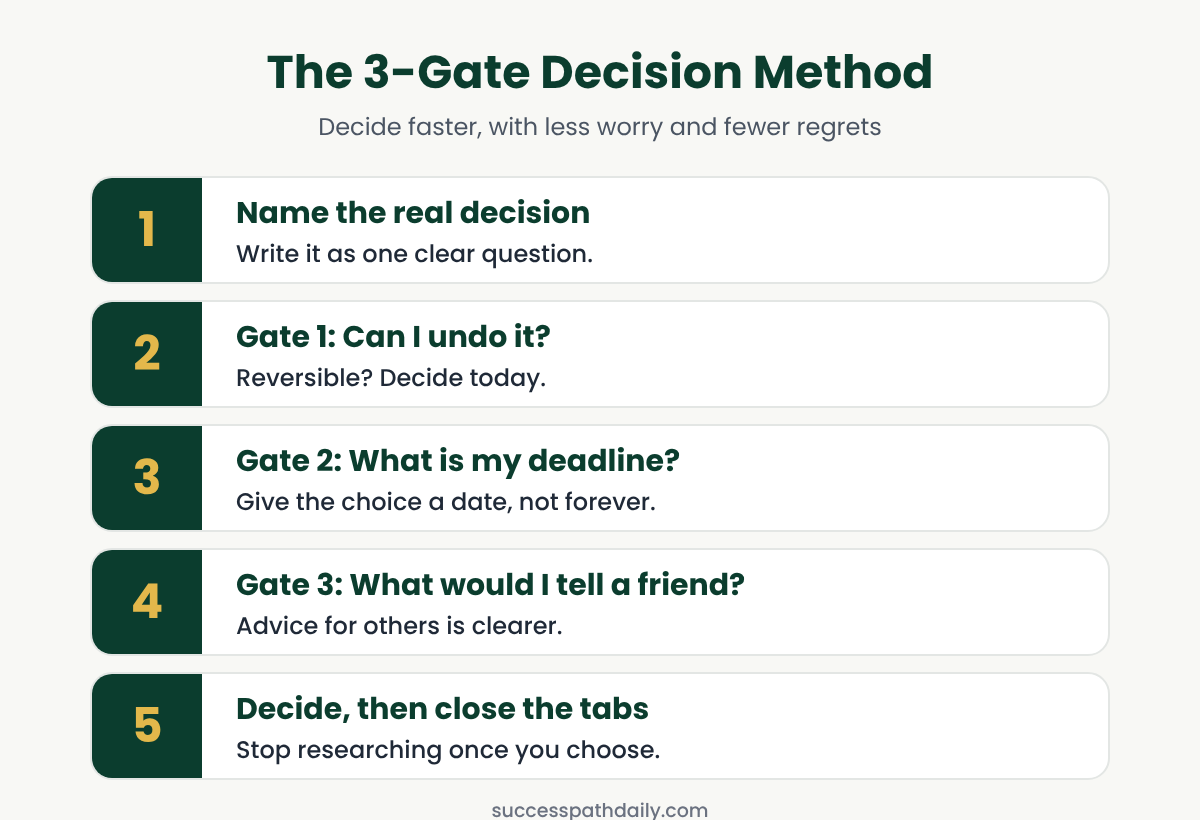
Run every decision through these three gates. Most decisions get through in under five minutes.
Step 1: Name the Real Decision
Write the decision as one clear question. "Should I take the apartment on Oak Street?" is easier to answer than a cloud of worries about moving, money and the future.
Step 2: Gate 1, Can I Undo It?
If the answer is yes, or mostly yes, decide today. Pick the option that looks best right now and move on. You can always adjust later. Most everyday choices, purchases and plans pass through this gate quickly.
Step 3: Gate 2, What Is My Deadline?
For choices that are harder to undo, give yourself a clear deadline, such as Friday at 6 p.m. Thinking without a deadline isn't planning. It's worrying. A deadline turns endless thinking into focused thinking.
Step 4: Gate 3, What Would I Tell a Friend?
Imagine a close friend described your exact situation to you. What would you advise them? We're usually much clearer and kinder when we advise others. Write down that advice, then take it yourself.
Step 5: Decide, Then Close the Tabs
Once you choose, stop researching. Close the tabs, delete the comparison list and stop asking for opinions. Looking for more information after deciding only feeds doubt. Your job now is to make the choice work.
7 Quick Tricks to Make Decisions Faster
- The 2-minute rule: if a decision would take less than two minutes to undo, make it in less than two minutes.
- Limit yourself to 3 options: cut the list to three before you compare anything.
- Aim for "good enough": decide what "good enough" looks like first, then pick the first option that meets it.
- Flip a coin: not to let the coin decide, but to notice how you feel when it lands. Relief or disappointment tells you what you really want.
- Ask two people, not ten: more opinions usually add confusion, not clarity.
- Sleep on it once: for big decisions, one night is helpful. Five weeks is avoidance.
- Decide in the morning: your mind is fresher, so important choices often feel easier before decision fatigue builds up.
How to Stop Replaying a Decision After You've Made It
For many overthinkers, the hardest part comes after the decision. The mind keeps asking, "What if I chose wrong?" Here's what helps:
- Remember what you knew then: you made the best choice with the information you had. Judging it with hindsight isn't fair.
- Look for what's working: list three good things about the option you chose.
- Set a review date: if a decision is reversible, agree to review it in a month instead of every night.
Lauren uses all three. When she chose her next apartment, she noticed the doubt arrive, wrote down three things she loved about the place and let the thought go.
Big Decisions vs Small Decisions
Not every choice deserves the same amount of thought. A simple rule: the time you spend deciding should match how hard the choice is to undo.
- Small and reversible: what to eat, what to wear, which book to read next. Decide in seconds.
- Medium: a new phone, a weekend trip, a gym membership. Decide within a day.
- Big and hard to undo: a career change, a home, a major investment. Use all three gates and a clear deadline of a few days or weeks.
Overthinkers often give small decisions big-decision energy. Saving your deep thinking for the few choices that truly matter is one of the fastest ways to feel lighter.
The Hardest Part: The Big Decisions That Keep You Up at Night
The 3-Gate Method works beautifully for everyday choices. But some decisions feel different: changing careers, ending a relationship, moving cities, starting a business. These are the ones that keep people awake for months. For choices like these, many people find it helps to follow a clear, repeatable process, so they can decide calmly and live with the result without second-guessing.
Want a System for the Big Decisions?
If you'd like a ready-made system for the big choices that keep you up at night, The No-Regret Decision System is worth a look. See it for yourself and decide whether it fits the way you think.
Whatever you choose, the three gates above work on their own, starting today.
Frequently Asked Questions
Why do I overthink every decision?
Overthinking usually comes from fear of regret, perfectionism, too many options or decision fatigue. It often feels like being careful, but it mostly keeps you stuck.
How can I make decisions faster?
Ask whether the decision can be undone. If it can, decide quickly. For bigger choices, set a deadline and ask what you would advise a friend to do.
What is analysis paralysis?
Analysis paralysis is when you overthink a choice so much that you can't make it at all. Limiting your options and setting a deadline helps break it.
Is overthinking a sign of intelligence?
Not necessarily. Thoughtful people do overthink, but deciding well depends on knowing when to stop thinking and start acting.
When should I get help for overthinking?
If overthinking comes with constant worry, affects your sleep for weeks or makes daily life hard, it's a good idea to talk to a doctor or a counselor.
Conclusion: Most Doors Swing Both Ways
Lauren lost the apartment she loved because she couldn't stop looking for something better. Her father's sentence changed that: most doors swing both ways.
Today, try the 3-Gate Method on one small decision you've been putting off. Ask if you can undo it, set a deadline and imagine what you'd tell a friend. Then decide, and close the tabs.
You don't need to be 100% sure. You just need to be brave enough to choose.
Affiliate link: we may earn a commission at no extra cost to you.
💬 Did this guide help you? Leave a comment below. Your comments encourage us to keep going and write more guides like this.
🎁 Your free gift: Download our free e-book, The Money Mindset Shift, right now.
Read Next
- How to Make Better Decisions: A Simple Framework
- Growth Mindset vs Fixed Mindset: Examples and How to Change
- Theta Waves: What They Are and What They Do for Your Brain
✨ Your turn ✨
Has this happened to you, or is something still on your mind?
Your story may help another reader who feels the same. We read and reply to every comment.
✍️ Share your storyor just tap one
💖 Thank you! Want to tell us more? Write your comment here ↓
 Next in this seriesHow to Make Better Decisions: A Simple FrameworkBig or small, every decision shapes your life. This simple five-step framework will help you think clearly, choose with confidence and stop second-gueRead it now →
Get the free e-books
Join our free newsletter and get instant access to all our free e-books, plus one practical tip each week.


Join the conversation
No comments yet. Be the first to share your story or your question. We reply to every comment.
Leave a comment