
Disclosure: This article contains affiliate links. If you buy through them, we may earn a commission at no extra cost to you. We only recommend products we believe may genuinely help. Read our full disclosure
Many of the beliefs that shape your finances sit quietly in the background. You may not notice them until you slow down and put them on paper. That's exactly what money journaling helps you do.
In this guide, you'll learn what money journaling is, why it works, how to start in just five minutes a day and 30 money journal prompts to help you improve your relationship with money, one page at a time.
What Is Money Journaling?
Money journaling means writing regularly about your thoughts, feelings, habits and goals around money. Unlike a budget, which tracks numbers, a money mindset journal tracks what's happening in your head and heart when money comes up.
Some entries will be reflective, like exploring a childhood memory. Others will be practical, like planning your next step toward a savings goal. Both kinds are valuable.
Benefits of Money Journaling
• Awareness: you start to notice the beliefs and emotions behind your spending and saving.
• Less money stress: writing down worries can make them feel smaller and easier to handle.
• Clearer goals: putting goals on paper helps you define what you really want.
• Better habits: regular reflection helps you spot patterns and make small changes.
• More gratitude: noticing what you already have builds a sense of abundance.
How to Start a Money Journal in 5 Simple Steps
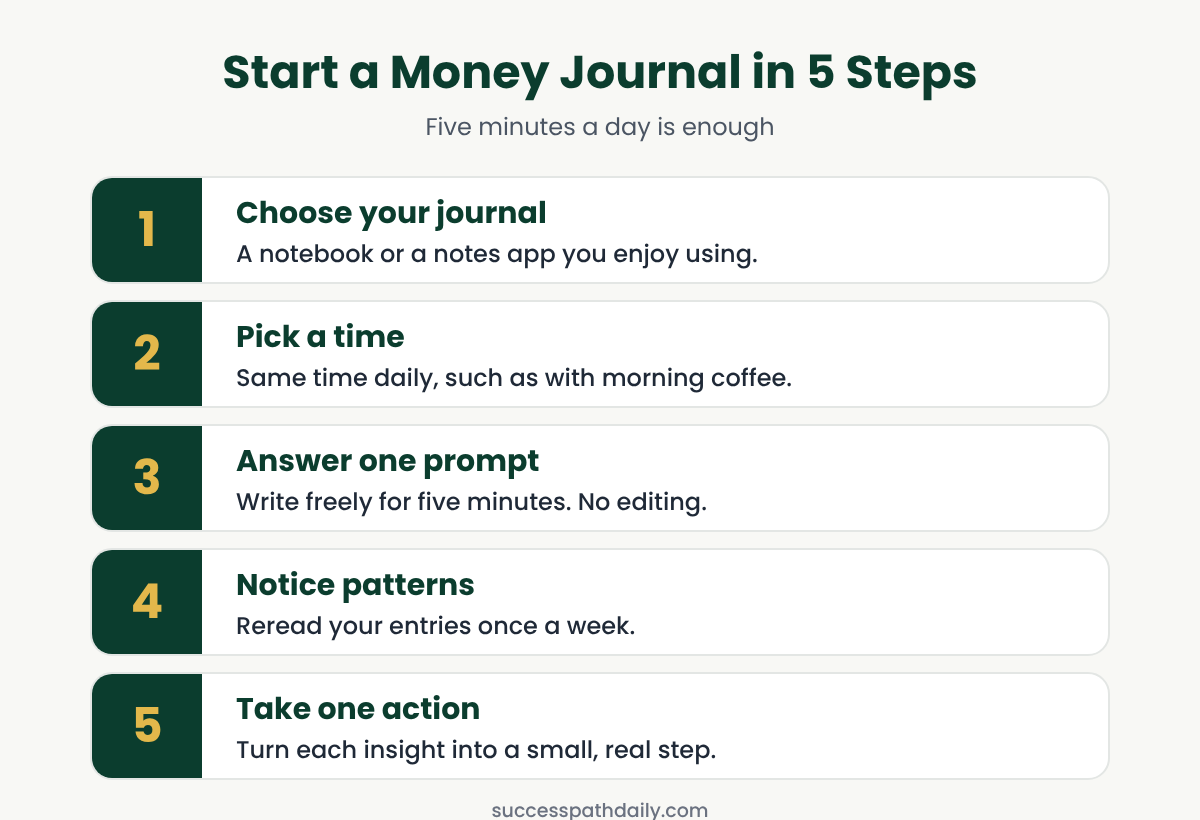
1. Choose your journal. A simple notebook works well, but a notes app is fine too. Pick something you enjoy opening.
2. Pick a regular time. Attach journaling to an existing habit, such as your morning coffee or the last ten minutes before bed.
3. Answer one prompt. Choose a prompt from the list below and write freely for five minutes. Don't edit or judge your words.
4. Notice patterns. Once a week, reread your entries. Look for repeated fears, beliefs or wishes.
5. Take one action. Turn at least one insight each week into a small, real step, like cancelling an unused subscription.
30 Money Journal Prompts
We've grouped the prompts into five themes. You can work through them in order, one per day for 30 days, or simply pick the one that speaks to you today.
Your Money Story (Prompts 1 to 6)
1. What did money mean in my family when I was growing up?
2. What is my earliest memory involving money, and how did it make me feel?
3. What phrases about money did I hear often as a child?
4. Who was the best role model for money in my life, and what did they do well?
5. What money mistake from my past am I ready to forgive myself for?
6. If my money story were a book, what would the current chapter be called?
Money Beliefs (Prompts 7 to 12)
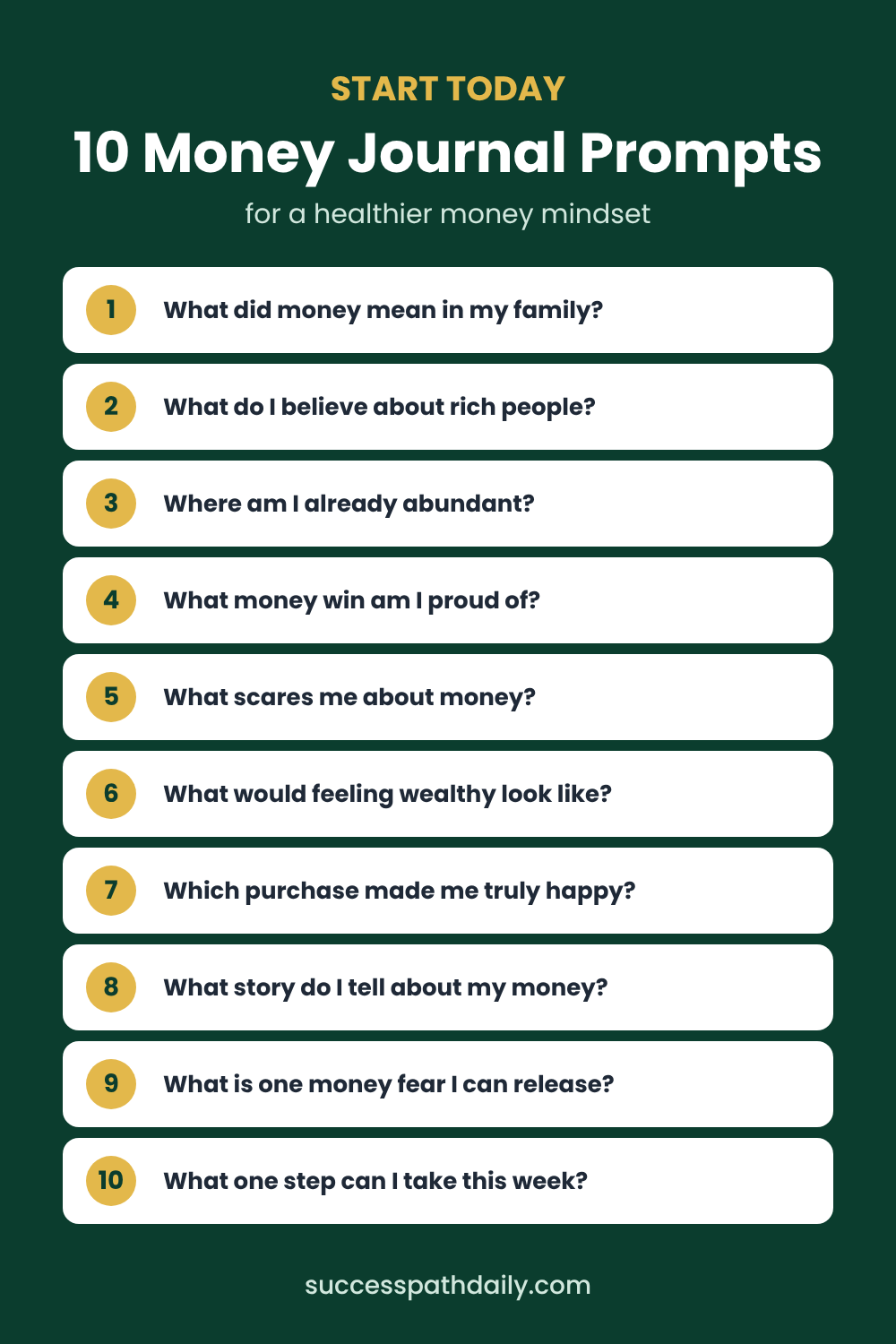
7. What do I truly believe about rich people?
8. Finish this sentence five times: "Money is..."
9. Which of my money beliefs came from someone else, and do I still agree with it?
10. What scares me most about having more money?
11. What would I have to believe to feel comfortable earning twice as much?
12. What is one limiting money belief I can rewrite today, and what will the new version be?
Gratitude and Abundance (Prompts 13 to 18)
These journal prompts for abundance help you notice what is already going well.
13. What are five things money has allowed me to enjoy this week?
14. Where in my life am I already abundant (friends, time, skills, health)?
15. What money win, big or small, am I proud of?
16. Which purchase in the past year brought me real, lasting happiness?
17. Who has been generous to me, and how did it feel?
18. How can I share a little of what I have this month?
Goals and Vision (Prompts 19 to 24)
Many readers also use these as manifestation journal prompts, writing as if the goal has already happened.
19. What would "feeling wealthy" look like in my everyday life?
20. Describe an ordinary day in my life five years from now, if money were working well for me.
21. What are my three most important money goals for the next 12 months?
22. Why do these goals matter to me, beyond the money itself?
23. What would I do with an extra $500 a month?
24. What kind of person do I need to become to reach my biggest money goal?
Action and Habits (Prompts 25 to 30)
25. What is one money task I've been avoiding, and what is the smallest first step?
26. Where did my money go last week, and how do I feel about it?
27. Which spending habit no longer serves me?
28. What skill could help me increase my income this year?
29. What will my weekly "money date" look like, and when will I schedule it?
30. What is one action I can take this week to move closer to my goals?
Tips to Get the Most From Your Money Journal
• Be honest: no one else needs to read your journal, so write what you really feel.
• Keep it short: five focused minutes are better than an hour you skip.
• Write by hand when you can: many people find it slows their thinking and brings deeper answers.
• Revisit old entries: rereading after a month shows how far you've come.
• Pair reflection with action: insights grow into results only when you act on them.
Tools That May Support Your Money Journaling Practice
Some people like to pair journaling with a short audio routine, listening before or after they write to help them feel relaxed and focused. One audio program often mentioned by readers interested in money mindset is The Money Wave.
The Money Wave is a short audio track of about seven minutes, according to its promotional materials, that listeners play with headphones, often first thing in the morning. Its creators say the sound is designed to help "tune" the brain toward wealth and abundance. Because it takes only a few minutes, some people like to play it just before a journaling session, then write while their mind feels calm and focused.
Claims made about sound, brain waves and the subconscious mind haven't been confirmed by strong scientific research, and results vary. We see it as an optional extra, not a replacement for journaling and practical money habits. Check the official website for current pricing and the refund policy before deciding.
Frequently Asked Questions
What is money journaling?
Money journaling is the practice of writing regularly about your thoughts, feelings, habits and goals around money. It helps you understand your beliefs, reduce money stress and make more intentional financial choices.
How often should I use money journal prompts?
Daily is ideal, even for five minutes, but a few times a week still works well. Consistency matters more than how much you write.
Can journaling really change your relationship with money?
Journaling won't change your bank balance by itself, but it can reveal the beliefs and emotions behind your money habits. That awareness makes it much easier to change your behavior over time.
What should I write in a money journal?
Write about your money memories, beliefs, worries, wins and goals. If you feel stuck, start with one of the 30 prompts above and write freely for five minutes.
Is a money journal the same as a budget?
No. A budget tracks numbers, such as income and spending. A money journal explores the thoughts and feelings behind those numbers. Many people find the two work well together.
Conclusion
Money journaling is one of the simplest ways to understand and improve your relationship with money. With just a notebook and five minutes a day, you can explore your money story, rewrite limiting beliefs, practice gratitude and turn insights into action.
Choose one of the 30 money journal prompts above and write your first entry today. Bookmark this page, and come back tomorrow for the next one.
Affiliate link: we may earn a commission at no extra cost to you.
Get the free ebook: The Money Mindset Shift
Join our free newsletter and get the ebook straight away, plus one practical money mindset tip each week.

Comments
No comments yet. Be the first to share your thoughts.
Leave a comment