

Disclosure: This article contains affiliate links. If you buy through them, we may earn a commission at no extra cost to you. We only recommend products we believe may genuinely help. Read our full disclosure
⚡ Key takeaways
- A scarcity mindset makes money feel short even when it isn't.
- You can spot it through 8 common signs and one hidden thought.
- 6 small steps help you move toward an abundance mindset.
In this article
Let's start with a small puzzle.
Daniel was 42. He had a good job as a project manager. He earned more than ever before. He had a nice apartment and no big debts.
So why did he check his bank app three times a day?
Why did his heart race every time he paid for dinner? Why did he say no to a promotion that could have doubled his pay in two years? And why, every December, did he spend all his savings on things he didn't even want?
Daniel thought he had a money problem. He didn't. He had a thought problem. One hidden thought had been running his money life for twelve years.
He only found it when a coworker asked him one strange question at lunch. We'll share that question in a minute. It might show you something about your own money, too.
But first, let's look at what a scarcity mindset really is. It's probably not what you think.
(Some readers also use a short daily audio called The Money Wave. More about that near the end.)
(Daniel is not his real name. His story is based on things many people go through.)
What Is a Scarcity Mindset?
A scarcity mindset is a deep feeling that there is never enough. Not enough money. Not enough time. Not enough chances.
Here is the surprising part. It has nothing to do with how much you earn. Some people with small incomes feel calm about money. And some people with big incomes feel scared all the time.
When you feel you don't have enough, your mind gets narrow. It only looks at the problem right in front of you. That is helpful in a real emergency. But when the feeling never turns off, it pushes you into bad choices. You grab quick comfort. You miss the bigger picture.
That's the trap. A scarcity mindset makes you feel careful. But in truth, it keeps your money tight.
Scarcity Mindset vs Abundance Mindset
"Abundance" just means "more than enough." An abundance mindset is not about being happy all the time. It's about where your eyes go.
- Scarcity asks: "What if I lose what I have?" Abundance asks, "What can I build with what I have?"
- Scarcity sees: other people's success as a threat. Abundance sees it as proof that good things are possible.
- Scarcity grabs: quick comfort now, even if it costs more later. Abundance can wait for something better.
- Scarcity says: "I can't afford it." Abundance says, "How could I afford it, and is it worth it?"
An abundance mindset does not mean spending a lot. It means seeing your choices clearly, without fear in the way.
8 Signs of a Scarcity Mindset
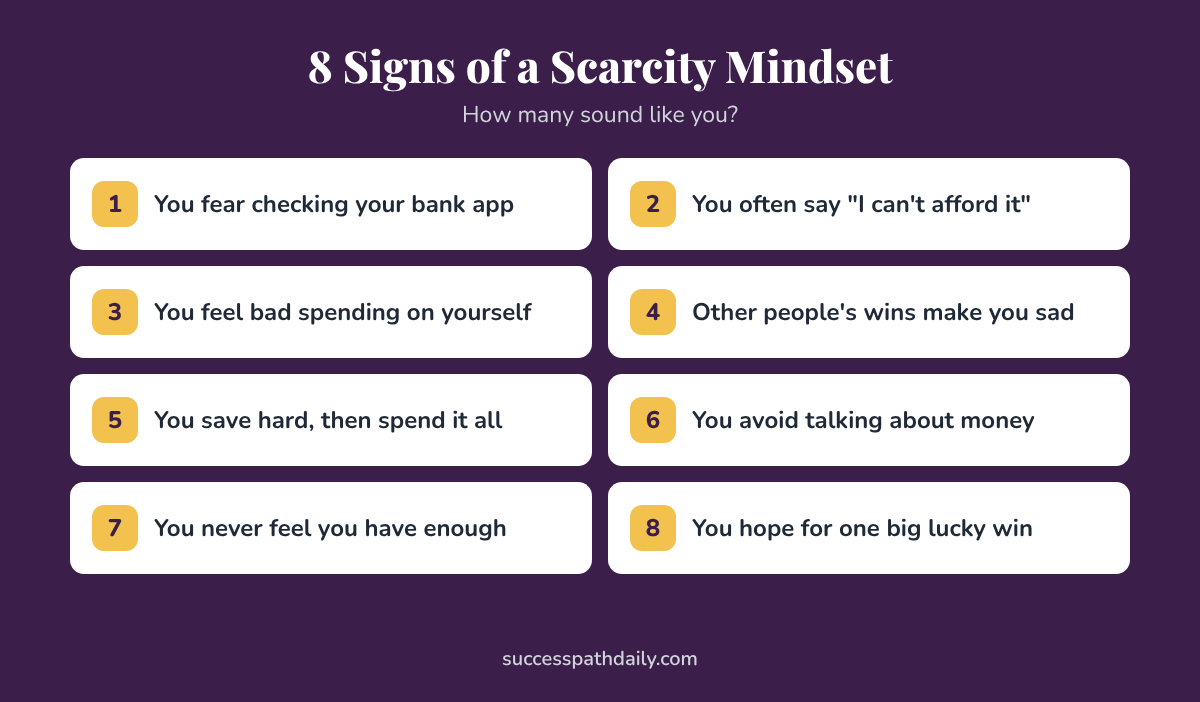
Read these slowly. Count how many sound like you.
1. You fear checking your bank app, even when you know the money is there.
2. You often say "I can't afford it," sometimes before you even check.
3. You feel bad spending on yourself, even on small, normal things.
4. Other people's wins make you sad instead of happy for them.
5. You save hard, then spend it all. Months of saving end in one big shopping trip.
6. You avoid talking about money with your partner, family or boss.
7. You never feel you have enough, no matter how much you earn.
8. You hope for one big lucky win to finally make you feel safe.
 You might also likeMorning Affirmations for Wealth and CalmRead it now →
0 to 2: you are mostly doing fine with money. 3 to 5: scarcity is quietly making some of your choices. 6 to 8: you are where Daniel was. This next part is for you.
The Lunch Question
One day at lunch, Daniel told his coworker Maria that he had said no to the promotion.
Maria put down her fork. Then she asked: "When you were a kid, what happened when money ran out?"
Daniel didn't answer for a long time.
Then he told her about one winter. His dad lost his job. The heat in their house was turned off for two weeks. His mom cried at the kitchen table. Daniel was nine years old.
Maria said softly, "So now, every time you have a money choice, that nine-year-old boy is still trying to keep the heat on."
That was it. That was the hidden thought. It wasn't "I'm bad with money." It wasn't "I don't earn enough." It was this: "Money can disappear at any moment, so I must hold on tight."
That thought made sense for a scared little boy. But Daniel was a grown man now, with savings and skills. The thought was guarding him from a danger that was long gone. And it was costing him peace, chances and even that promotion.
Most people with a scarcity mindset have a hidden thought like Daniel's. Yours may be different. But it is almost always an old rule from a time when you had less control than you do now.
How to Find Your Own Hidden Money Thought
Take ten quiet minutes and a notebook. Answer these three questions. Don't think too hard. Write the first thing that comes.
- How did money feel in your home growing up? Calm? Tense? Secret? A reason to fight?
- What did you hear about money most often? "We can't afford that"? "Money doesn't grow on trees"? "Don't tell anyone what we earn"?
- What are you most scared will happen with money? Losing it all? Being judged? Being tricked?
Now look at your answers. Look for a rule hiding under them. It often starts with "Money is..." or "People like me..." Once you see it on paper, it loses a lot of its power.
How to Flip a Scarcity Mindset: 6 Small Steps

1. Name the Fear Thought
When money fear shows up, say it out loud or in your head: "This is my scarcity thought talking." Just naming it puts a little space between you and the fear.
2. Look at the Real Numbers
Fear loves fog. So open your bank app and look at the real numbers. Often, things are calmer than the feeling. And if they are not, now you have a real problem you can work on. That is much better than a cloud of worry.
3. Write What You Already Have
Make a list of your skills, savings and people who support you. Scarcity hides these from you. Seeing them on paper reminds you that you have more choices than you think.
4. Change "Can't" to "How"
Every time you think "I can't afford it," ask "How could I afford it, and is it worth it to me?" Sometimes the answer is still no. But now it is your choice, not your fear's choice.
5. Give a Little, on Purpose
This one sounds strange. But giving even a few dollars to a cause you care about tells your brain, "I have enough to share." Many people find this loosens fear faster than anything else.
6. Write One Good Thing a Day
Each night, write one good money moment. A bill paid on time. A smart choice. A few dollars saved. Scarcity remembers every loss. This habit teaches your brain to remember the wins, too.
What Happened to Daniel
Daniel did not suddenly start spending a lot. He just became calmer.
He stopped checking his bank app three times a day. He set up a small automatic savings transfer every month. That way, the little boy inside him knew the "heat" would stay on.
Six months later, the same promotion opened up again. This time, Daniel applied. And this time, he got it.
He told Maria, "The money didn't change first. I did."
Watch Out for These Mistakes
- Spending too much: abundance is not about buying more. It's about choosing without fear.
- Ignoring real money problems: if you have debt or an emergency, deal with the numbers. Mindset and action go together.
- Expecting the fear to vanish: the fear may still visit. The goal is to stop letting it make your choices.
- Comparing yourself to others: everyone's money story started in a different place.
Good Days Are Easy. Hard Days Are the Test.
Finding your hidden thought is a big step. But it took years to build. So it takes daily practice to change.
Most people find the six steps easy on a good day. On a bad day, the old fear rushes back. That's why a short routine, done when you feel calm, can help a lot. It keeps the new thinking fresh, so it is ready when you need it.
A Morning Routine Some Readers Like
If you want something simple to do each morning, take a look at The Money Wave. It is a short daily audio built around feeling "more than enough." See it for yourself and decide if it fits your mornings.
Your Questions, Answered
What causes a scarcity mindset?
It often starts in childhood, when money was tight or scary. Later things, like losing a job or having debt, can make it stronger.
How do I stop having a scarcity mindset?
Find the hidden thought behind it. Check your real numbers. List what you have. Then practice small daily habits, like writing one money win each night.
Is a scarcity mindset the same as a poverty mindset?
They are very close. Both are fear-based ways of thinking about money. But a scarcity mindset can happen at any income.
Can you have a scarcity mindset with a high income?
Yes. Many people who earn a lot still feel scared about money. More money doesn't remove the hidden thought. Only seeing it and changing it does.
How long does it take to build an abundance mindset?
Many people feel calmer in a few weeks. A lasting change often takes a few months of small daily habits.
It Was Never Really About Money
For twelve years, Daniel fought a money problem. But really, it was a nine-year-old boy's fear. One kind question helped him see it. And once he could see it, he could change it.
Your hidden money thought is waiting for you to find it. Take ten minutes today with the three questions above. Write down the rule under your answers. Then start the six steps, one at a time.
The most costly thing you own might be a thought you never chose.
Affiliate link: we may earn a commission at no extra cost to you.
💬 Did this guide help you? Leave a comment below. Your comments encourage us to keep going and write more guides like this.
🎁 Your free gift: Join our free newsletter and get instant access to all our free ebooks, plus one practical tip each week.
Read Next
✨ Your turn ✨
Has this happened to you, or is something still on your mind?
Your story may help another reader who feels the same. We read and reply to every comment.
✍️ Share your storyor just tap one
💖 Thank you! Want to tell us more? Write your comment here ↓
 Next in this seriesMoney Blocks: 9 Signs You're Secretly Pushing Wealth AwayA bonus. A gift. A raise. Each time, the money vanished. One question showed him why. Here are 9 signs of a money block and how to clear yours.Read it now →
Get the free e-books
Join our free newsletter and get instant access to all our free e-books, plus one practical tip each week.

Join the conversation
No comments yet. Be the first to share your story or your question. We reply to every comment.
Leave a comment