

Disclosure: This article contains affiliate links. If you buy through them, we may earn a commission at no extra cost to you. We only recommend products we believe may genuinely help. Read our full disclosure
⚡ Key takeaways
- Your first few seconds in a money moment shape what you do next.
- The 7-second reset: notice, count to 7, ask a better question.
- 7 small daily shifts and the mistakes to watch out for.
In this article
Rachel did not know she had a "money sigh." Her little girl had to tell her.
They were sitting at the kitchen table, opening the mail. Rachel opened a bill. She looked at the number. Then she let out a long, sad breath.
Her daughter, who was seven, looked up. "Mom, why do you always do that when you open letters?"
Rachel laughed. But that night, she could not stop thinking about it. Her daughter was right. She sighed every time she looked at her bank app. Every time a bill came. Every time a friend said, "Let's eat out."
Rachel was a teacher. She had a steady job. She was not broke. But she felt broke, all the time.
Three months later, she had paid off a credit card she had carried for four years. She did not get a raise. She did not win any money. She just changed what she did in seven seconds.
And the idea came from her daughter, too. But not from that first question. It came from something the girl said a week later, at the grocery store. We'll get to that soon.
First, let's talk about what a money mindset shift really is. In this guide, you'll learn the 7-second habit, 5 money thoughts to flip and 7 small shifts you can start today.
(Some readers also listen to a short daily audio called Billionaire Brain Wave. We'll tell you more near the end.)
(We changed the names in this story. It is based on things many people go through.)
What Is a Money Mindset?
Your money mindset is how you think and feel about money. Most of it happens on its own. You don't decide to feel scared when you open a bill. It just happens.
A money mindset shift is when you catch one of those feelings and choose a new thought instead.
One shift is small. But think about how often money shows up in your day. A price tag. A bill. A payslip. A friend's new car. That is many small moments. If you change how you act in those moments, you change a lot over time.
Here is the part most people miss. You can't fix your money mindset by thinking happy thoughts once a day. The change happens in those tiny money moments. And each one lasts just a few seconds.
Quick Test: Is Your Money Mind on Autopilot?
Say yes or no to each question. Be honest. Nobody is watching.
- Do you feel a jump of fear when you check your bank balance?
- Do you say "I can't afford it" many times a week?
- Do you leave some bills or emails unopened?
- Do you feel bad when you spend money on yourself?
- Do you think other people are just "luckier" with money?
0 or 1 yes: you are doing well. The habit below will make you even stronger. 2 or 3: your quick reactions are costing you. 4 or 5: you are right where Rachel was. Keep reading.
Why the First Few Seconds Matter
Think of your mind as having two helpers.
The first helper is very fast. It sees a bill and shouts, "Danger!" The second helper is slow and calm. It can look at the bill and say, "It's okay. We can pay this."
The problem is that the fast helper always speaks first. And with money, most of us act on what it says. We hide the bill. We buy something to feel better. We say no to a good chance because it feels "too risky."
Rachel looked back at the money choices she was sorry about. She found that almost all of them started the same way. A quick, scared feeling in the first few seconds. A feeling she never stopped to check.
So she wondered: what if she could catch that feeling, just for a moment?
What Her Daughter Said at the Grocery Store
A week later, they were at the checkout. The total came up on the screen. Rachel sighed again.
Her daughter squeezed her hand. Very seriously, she said, "Mom, count to seven. That's what my teacher tells us when we get upset."
Rachel almost laughed. But she tried it. She counted to seven in her head. She let her breath out slowly. Then she asked herself one question: "Is this a real problem, or does it just feel like one?"
The total was fine. She could pay it. The fear had been a habit, not a fact.
Here is what Rachel learned that day. Her money problem was not her income. It was the seven seconds after money showed up. For years, a scared habit had been making her choices. A simple trick from a second-grade classroom gave her a pause. And in that pause, she could choose something better.
The 7-Second Money Reset: 3 Easy Steps
We call Rachel's habit the 7-Second Money Reset. You can do it anywhere: at a store, in your bank app or while reading a bill.
 You might also likeMorning Affirmations for Wealth and CalmRead it now →
Step 1: Notice the Money Moment
Catch the moment money shows up and your body reacts. Maybe your chest feels tight. Maybe you sigh. Just say to yourself, "Money moment." Giving it a name makes it smaller.
Step 2: Count to 7
Count slowly to seven. Breathe out a little longer than you breathe in. This is not magic. It just gives your slow, calm helper time to catch up.
Step 3: Ask a Better Question
Swap the scared thought for a question. Instead of "I can't afford it," ask "How could I afford it if I really wanted to?" Instead of "There's never enough," ask "What is this money doing for me right now?" Questions open your mind. Scared thoughts close it.
5 Money Thoughts to Flip Today

These are the five thoughts Rachel caught most often. Next to each one is the new thought she used. The new thoughts are not fake. They are just more useful, and more true.
- "I can't afford it" becomes "How can I afford it?" Now it is a puzzle to solve, not a dead end.
- "Money is always tight" becomes "I choose where my money goes." This puts you back in charge.
- "Rich people are lucky" becomes "Rich people built good habits." Habits can be learned. Luck can't.
- "I'm bad with money" becomes "I'm learning about money." Nobody is born good with money.
- "It's too late for me" becomes "Today is my day one." Every money story has a first day.
7 Small Money Mindset Shifts for Every Day
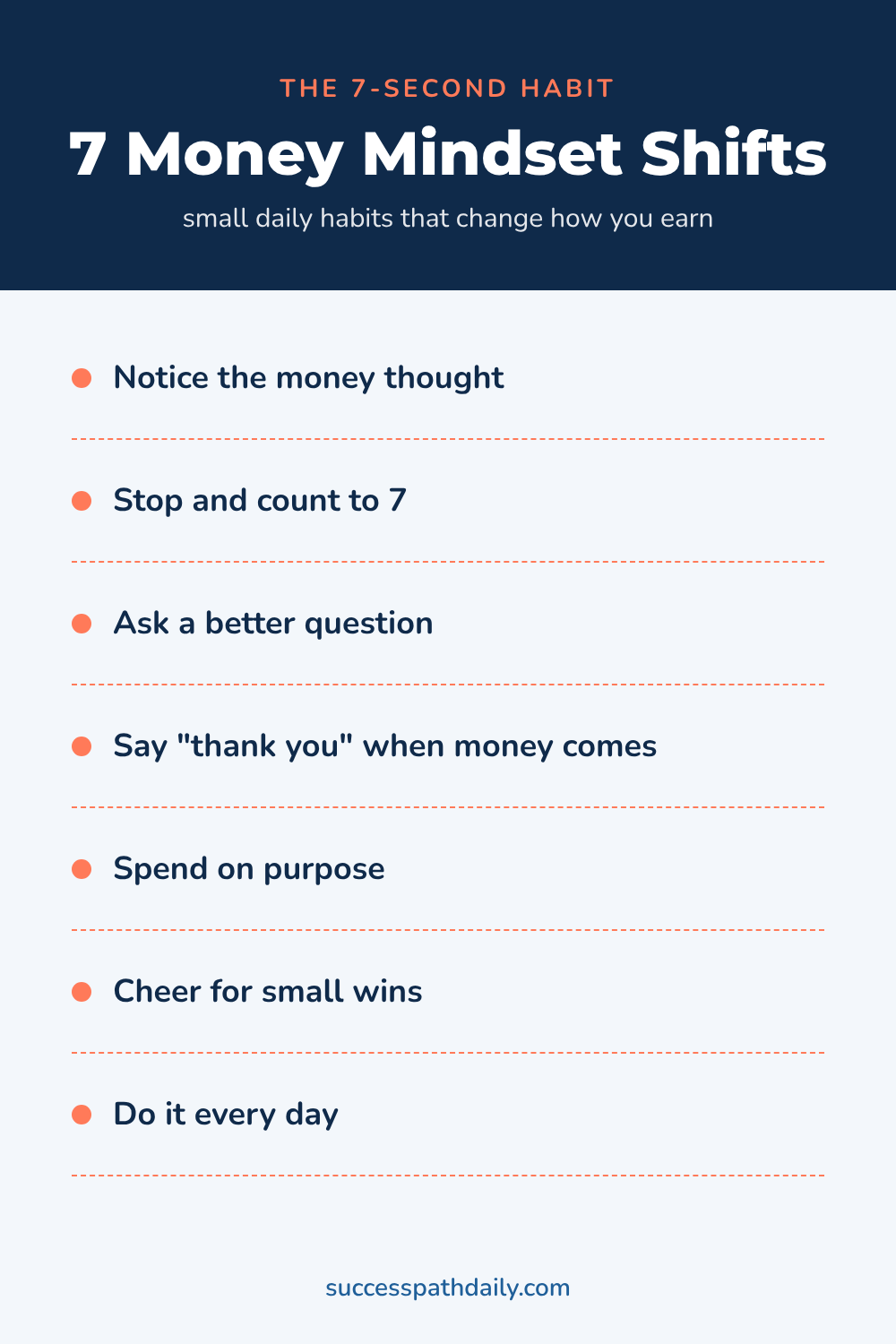
The 7-Second Money Reset is the main habit. These seven shifts help it stick. Try one a day for a week. Then keep the ones you like.
1. Notice the money thought. For one day, write down every money thought you catch. Most people are surprised how many are negative.
2. Stop and count to 7. Use the reset every time you open your bank app this week.
3. Ask a better question. Turn every "I can't" into "How could I?"
4. Say "thank you" when money comes. Even a small refund. This teaches your brain to notice money coming in, not just going out.
5. Spend on purpose. Before you buy, ask: "Do I want this, or do I just want to feel better?" Both are okay. Just know which one it is.
6. Cheer for small wins. Paid a bill on time? Saved $20? Smile about it. Your brain repeats what makes it feel good.
7. Do it every day. A new mindset grows from small steps, done again and again.
What Changed for Rachel (and What Didn't)
It was not fast. For the first two weeks, Rachel forgot to count more often than she remembered.
But in week three, something strange happened. She started to catch the sigh before it even came out.
She opened her bills on the day they came. She stopped buying little things to cheer herself up after a money scare. Those little things had added up to more than $150 a month. She put that money toward her credit card. Then, when the card was paid, she put it into savings.
What didn't change? Her pay. Her bills. Her life. What changed was the person handling them. That is the power of a money mindset shift. Life stays the same. But your choices get better.
4 Mistakes to Watch Out For
- Wanting quick results: a new mindset grows slowly. Give it at least 30 days.
- Saying things you don't believe: "I am a millionaire" can feel like a lie. Try "I'm getting better with money" instead.
- Forgetting the practical side: mindset works best with real steps, like a simple budget.
- Being hard on yourself: every time you catch an old habit, that is a win, even if you catch it late.
Why Old Money Habits Keep Coming Back
Let's be honest. Counting to seven works well in the moment. But your money habits were built over many years. On a calm day, the new habit is easy. On a stressful day, the old fear jumps back in.
Many people find it helps to add a short daily routine when they are calm. Some write in a journal. Some sit quietly for a few minutes. Some listen to a short audio. The best routine is the one you will really do every day.
A Daily Routine Some Readers Use
If you want a simple daily habit to support your new money mindset, take a look at Billionaire Brain Wave. It is a short audio of about seven minutes a day. Have a look and decide if it is right for you.
Think of it as a helper, not a shortcut. What you do with your new mindset is what really counts.
Questions People Often Ask
How long does a money mindset shift take?
Many people notice small changes in two or three weeks. Bigger habits can take a few months to feel normal.
What is the fastest way to change your money mindset?
Catch your quick money feelings in the moment. Then swap them for a better question. The 7-Second Money Reset is an easy way to do this every day.
Can a money mindset help you earn more?
A mindset alone does not make money. But a calmer money mind often leads to better choices, like saving, asking for a raise or starting a side income.
Why do I feel broke even when I earn enough?
Feeling broke is often a habit, not a fact. Look at your real numbers. Then practice calmer money reactions. Over time, the feeling starts to match the truth.
What are good money habits for beginners?
Start with three: notice your money thoughts, pause before you react and say thank you when money comes in.
Your Turn: Try It the Next Time Money Shows Up
Rachel thought she had a money problem. Really, she had a seven-second problem. A little girl's classroom trick gave her the pause she needed.
So try it today. The next time money shows up, notice it. Count to seven. Ask a better question. Then do it again tomorrow.
Your pay may not change this week. But the person in charge of it can.
Affiliate link: we may earn a commission at no extra cost to you.
💬 Did this guide help you? Leave a comment below. Your comments encourage us to keep going and write more guides like this.
🎁 Your free gift: Get our free ebook library, simple guides on money, mindset and side income. Download them right now.
Read Next
✨ Your turn ✨
Has this happened to you, or is something still on your mind?
Your story may help another reader who feels the same. We read and reply to every comment.
✍️ Share your storyor just tap one
💖 Thank you! Want to tell us more? Write your comment here ↓
 Next in this seriesWhat Is Money Energy? A Simple Guide for BeginnersYou may have heard people say money is "energy". This beginner-friendly guide explains what money energy really means, how to spot blocked money energRead it now →
Get the free e-books
Join our free newsletter and get instant access to all our free e-books, plus one practical tip each week.

Join the conversation
No comments yet. Be the first to share your story or your question. We reply to every comment.
Leave a comment