
Disclosure: This article contains affiliate links. If you buy through them, we may earn a commission at no extra cost to you. We only recommend products we believe may genuinely help. Read our full disclosure
⚡ Key takeaways
- Many money beliefs come from things we heard as children.
- 10 common money "lies" and why they stick.
- The 4-step rewrite: catch it, trace it, question it, rewrite it.
In this article
Before we begin, try this. Finish this sentence as fast as you can:
"Rich people are..."
What word popped into your head? Lucky? Greedy? Smart? Fake? Hold on to that word. We'll come back to it.
Now let us tell you about Melissa.
When Melissa was nine, she asked her grandmother why the family next door had a new car. Her grandmother pressed her lips together and said, "People with that kind of money didn't get it honestly."
It was one sentence. Said once. On a normal afternoon. Melissa forgot all about it.
Thirty years later, Melissa was a gifted graphic designer. But she always charged too little. She felt sick when she sent a bill to a client. And whenever someone offered her a big project, she found a reason to say no.
She was smart. She was skilled. She worked hard. But her income was stuck, as if there was an invisible ceiling over her head.
That ceiling had a name. And one day, in the middle of a meeting, it came back to her, word for word.
In this guide, you'll see the 10 most common limiting beliefs about money, where they come from and a simple 4-step way to change them. As you read, notice which ones make you stop. Those are the ones that matter. (Number 6 surprises almost everyone.)
(Some readers also watch a short free video called The Wealth Signal after this. More about it near the end.)
(We changed Melissa's name and some details. Her story is based on things many people go through.)
What Is a Limiting Belief About Money?
A limiting belief is a thought that feels like a fact, but it holds you back.
You don't notice it, because it doesn't feel like a belief. It feels like "just the way things are."
Take "rich people are greedy." If you heard it a lot as a child, it feels like common sense. But here is the problem. If part of you thinks rich people are bad, another part of you will try hard not to become one. No matter how hard you work.
That's why so many hard-working people stay stuck. Their effort says "go." Their beliefs say "stop." And beliefs usually win.
Remember the word you picked for "Rich people are..."? If it was a bad word, you may already have found one of your limiting beliefs.
Where Money Beliefs Come From

Most of our money beliefs are formed when we are young, long before our first paycheck. They usually come from three places:
- Home: what our parents said about money, and even more, what they did. Fights, silence or stress about bills all leave a mark.
- School and friends: comparing ourselves with other kids, wanting to fit in or feeling "less."
- TV and stories: movies where rich people are the bad guys, or where money only comes from luck.
This is not about blaming anyone. Our parents and grandparents passed on what they learned in their own hard lives. And here's the good news: anything we learned, we can unlearn.
10 Money Lies We Were Taught as Kids

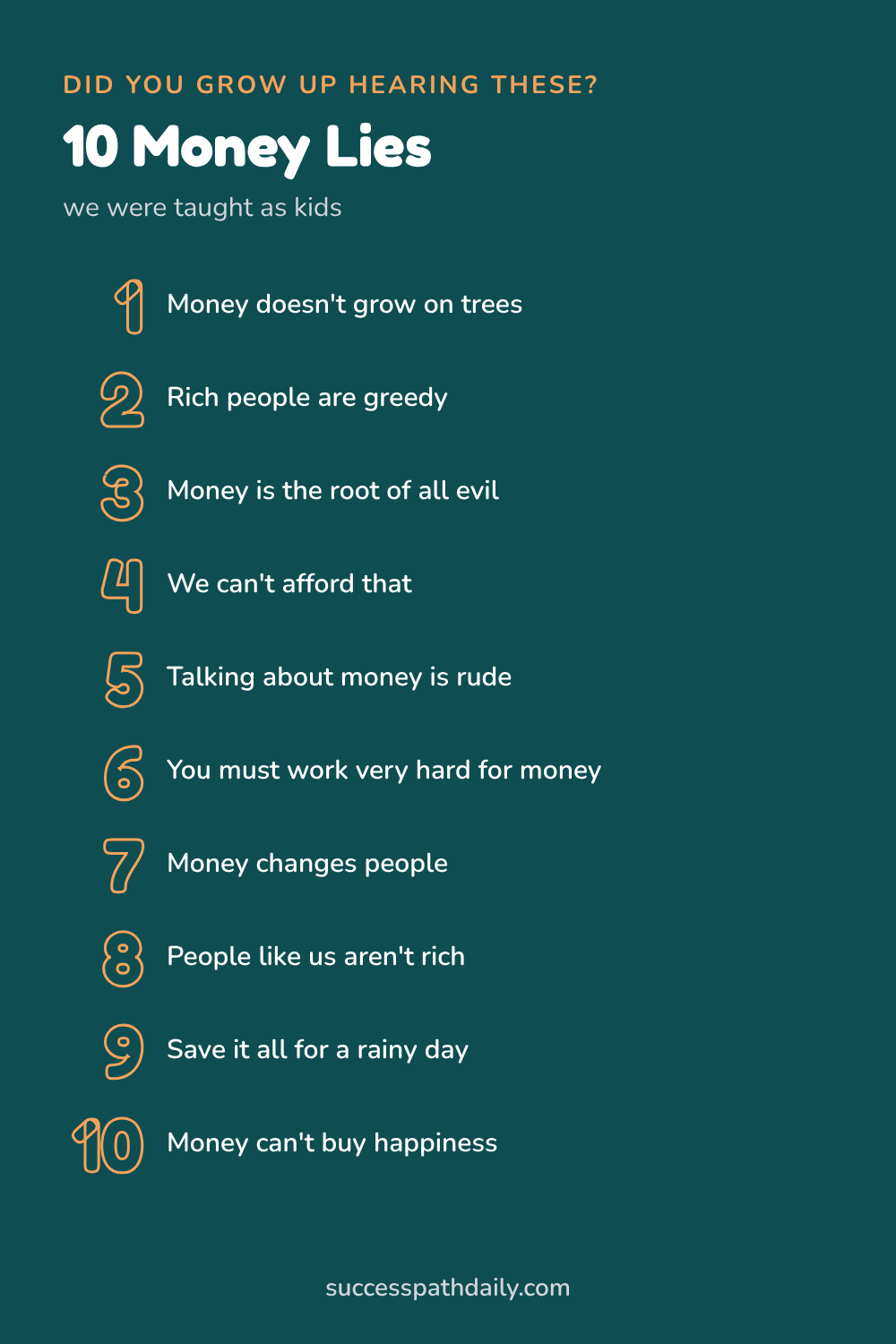
1. "Money Doesn't Grow on Trees"
Parents say it to teach care. But kids often hear: "Money is rare and very hard to get." As adults, they may feel more money is always out of reach.
2. "Rich People Are Greedy"
This was Melissa's belief. If having money means being a bad person, earning more feels wrong. So you hold yourself back without knowing it.
3. "Money Is the Root of All Evil"
This is usually said wrong. The old saying is about the love of money, not money itself. Money is a tool. It can build homes, help schools and feed families.
4. "We Can't Afford That"
Hear it enough, and it becomes automatic. Many adults say it before they even look at the price or think of a way.
5. "Talking About Money Is Rude"
When nobody talks about money, nobody learns. People don't ask for a fair salary. They don't ask questions. And it costs them.
6. "You Must Work Very Hard for Money"
This is the one that surprises people, because it sounds like good advice. Hard work matters. But this belief can trap you. It says money only comes from being tired and worn out. So you never look for smarter ways to earn, like new skills or a side income. And if money ever comes easily, you feel like you don't deserve it.
7. "Money Changes People"
If you think money will turn you into someone bad, part of you will keep money away to protect you. In truth, money usually makes you more of who you already are.
8. "People Like Us Aren't Rich"
This one is very strong. It ties who you are to how much you have. So earning more can feel like leaving your family behind.
9. "Save It All for a Rainy Day"
Saving is wise. But when every dollar is kept for a future disaster, you may never spend on learning, growing or good chances.
10. "Money Can't Buy Happiness"
Money can't buy everything. But having enough does take away a lot of stress. Sometimes this belief becomes an excuse to never try to do better.
The Day the Sentence Came Back
Melissa was meeting a new client. The client, a kind woman who owned a small company, offered her a big contract. It paid three times more than Melissa's usual rate.
Melissa opened her mouth to say yes. And suddenly, she heard her grandmother's voice in her head: "People with that kind of money didn't get it honestly."
She actually laughed out loud. The client looked confused. Melissa said sorry, asked for one day to think and drove home shaking.
That night, she wrote the sentence on a piece of paper. Under it, she wrote: "Is this true?"
She thought about the client. A hard-working woman who had built her business over twenty years. The money was honest. And Melissa's work was worth it.
Here's what she discovered. A limiting belief is strongest when you can't see it. The moment you write it down and question it, it starts to lose its grip. Melissa signed the contract the next morning.
How to Break a Money Belief: The 4-Step Rewrite
Step 1: Catch It
Notice when you stop, feel guilty or say no to money. Ask, "What am I believing right now?" Write the exact sentence down.
Step 2: Trace It
Ask, "Where did I learn this?" A parent? A teacher? A TV show? When you see where it came from, you see it was someone else's rule, not a law of life.
Step 3: Question It
Ask, "Is this always true? Can I think of one time it wasn't?" Find one kind, honest person who has money. Or one time money came to you easily. One example is enough to crack the belief.
Step 4: Rewrite It
Write a new belief that feels true enough to accept. Not "I am a millionaire." Something believable, like "Money can be earned honestly, and I can earn it by helping people." Read it every morning for 30 days.
Simple Belief Swaps to Try Today
- "Rich people are greedy" becomes "Many people use money to help others, and so can I."
- "You must work very hard for money" becomes "I can earn through skills and smart choices, not just tiredness."
- "People like us aren't rich" becomes "My family's story is where I start, not where I stop."
- "Talking about money is rude" becomes "Talking about money helps me make better choices."
Mistakes That Slow You Down
- Fighting the belief: arguing with it makes it louder. Be curious about it instead.
- Picking new beliefs that feel fake: if it feels like a lie, your mind will push it away.
- Stopping after a week: beliefs that took years to build need weeks to change.
- Doing it only in your head: write it down. Seeing the words on paper makes a real difference.
Some Beliefs Hide Deeper Than Words
Here's the honest truth. You can catch and rewrite the beliefs you notice. But some money beliefs live deeper. They live in feelings and habits that are hard to put into words.
You know the feeling. You "know" something is not true, but you still feel it. That's why some people add a daily practice that works on that quieter, deeper level too.
Want to Look at the Deeper Level?
If you feel your money beliefs go deeper than your thoughts, The Wealth Signal looks at this in a different way. The short free video is worth a look.
Watch it with an open mind and decide for yourself. Real change still comes from what you do next.
Quick Questions
What are some examples of limiting beliefs about money?
Common ones are "money doesn't grow on trees," "rich people are greedy," "I'm bad with money," "people like us aren't rich" and "you must work very hard for money."
How do I know if I have negative money beliefs?
Notice where you stop, feel guilty or avoid money. Charging too little, hiding from bills or feeling uncomfortable with gifts are common signs.
Can you change your money beliefs as an adult?
Yes. Beliefs are learned, so they can be learned again in a new way. Catch, trace, question and rewrite them for a few weeks.
Where do money beliefs come from?
Mostly from childhood: what our family said and did, what happened at school and the stories we saw on TV.
How long does it take to change a money belief?
Sometimes it changes in one moment, like Melissa's. Most beliefs need about 30 days of daily practice to feel normal.
Whose Belief Are You Living?
Melissa lived for thirty years by a sentence she didn't even remember. The day she wrote it down and asked, "Is this true?", her ceiling began to lift.
Now think back to the very start of this guide. What word did you pick for "Rich people are..."? Write it down today. Then trace it, question it and rewrite it.
The biggest thing between you and more money might not be your skills. It might be a sentence someone gave you a long time ago.
Affiliate link: we may earn a commission at no extra cost to you.
💬 Did this guide help you? Leave a comment below. Your comments encourage us to keep going and write more guides like this.
🎁 Your free gift: Join our free newsletter and get instant access to all our free ebooks, plus one practical tip each week.
Read Next
✨ Your turn ✨
Has this happened to you, or is something still on your mind?
Your story may help another reader who feels the same. We read and reply to every comment.
✍️ Share your storyor just tap one
1 reader found this helpful
💖 Thank you! Want to tell us more? Write your comment here ↓
 Next in this seriesScarcity Mindset: The Hidden Thought Keeping You Broke (and How to Flip It)He earned good money but still felt broke every day. One question over lunch showed him the hidden thought behind it. Here is how to find yours.Read it now →
Get the free e-books
Join our free newsletter and get instant access to all our free e-books, plus one practical tip each week.


Join the conversation
No comments yet. Be the first to share your story or your question. We reply to every comment.
Leave a comment