
Disclosure: This article contains affiliate links. If you buy through them, we may earn a commission at no extra cost to you. We only recommend products we believe may genuinely help. Read our full disclosure
⚡ Key takeaways
- Feeling like a fraud is very common, even for skilled people.
- The 5 common types and why it happens.
- 9 ways to quiet it, including an evidence file.
In this article
Emily is 29 and was just promoted to team lead at a software company in Colorado. Her manager praised her work in front of everyone. Her family took her out to dinner. And that night she lay awake, heart racing, sure that it was a mistake.
"They'll realize I don't really know what I'm doing," she thought. "It's only a matter of time before they find out."
Emily isn't a fraud. She's experiencing imposter syndrome, a very common feeling among capable people. In this guide we'll explain what it is, why it happens and 9 practical ways to quiet it, so your successes can finally feel like yours.
(We changed the names and some details. This story is based on things many people go through.)
What Is Imposter Syndrome?
Imposter syndrome (also spelled impostor syndrome) is the persistent feeling that you don't deserve your success, and that sooner or later people will discover you're not as capable as they think. You may put your achievements down to luck, timing or other people's kindness, rather than your own ability and effort.
The idea was first described in 1978 by psychologists Pauline Clance and Suzanne Imes, who noticed it in many high-achieving women. Since then, research has shown it affects people of every gender, age and job. A 2020 review of studies found reported rates ranging widely, from 9% to 82% depending on the group studied.
It's not an official medical diagnosis. It's a pattern of thinking, and patterns of thinking can change.
Signs of Imposter Syndrome
- You credit luck "I just happened to be in the right place."
- You fear being "found out" even after years of good work.
- You can't accept praise and quickly point out what went wrong.
- You over-prepare or put things off because they must be perfect.
- You compare yourself with others and always come out worse.
- You hesitate to apply or speak up unless you are 100% ready.
The 5 Common Types of Imposter Syndrome
Researcher Dr. Valerie Young describes five common patterns. Many people recognize themselves in more than one.
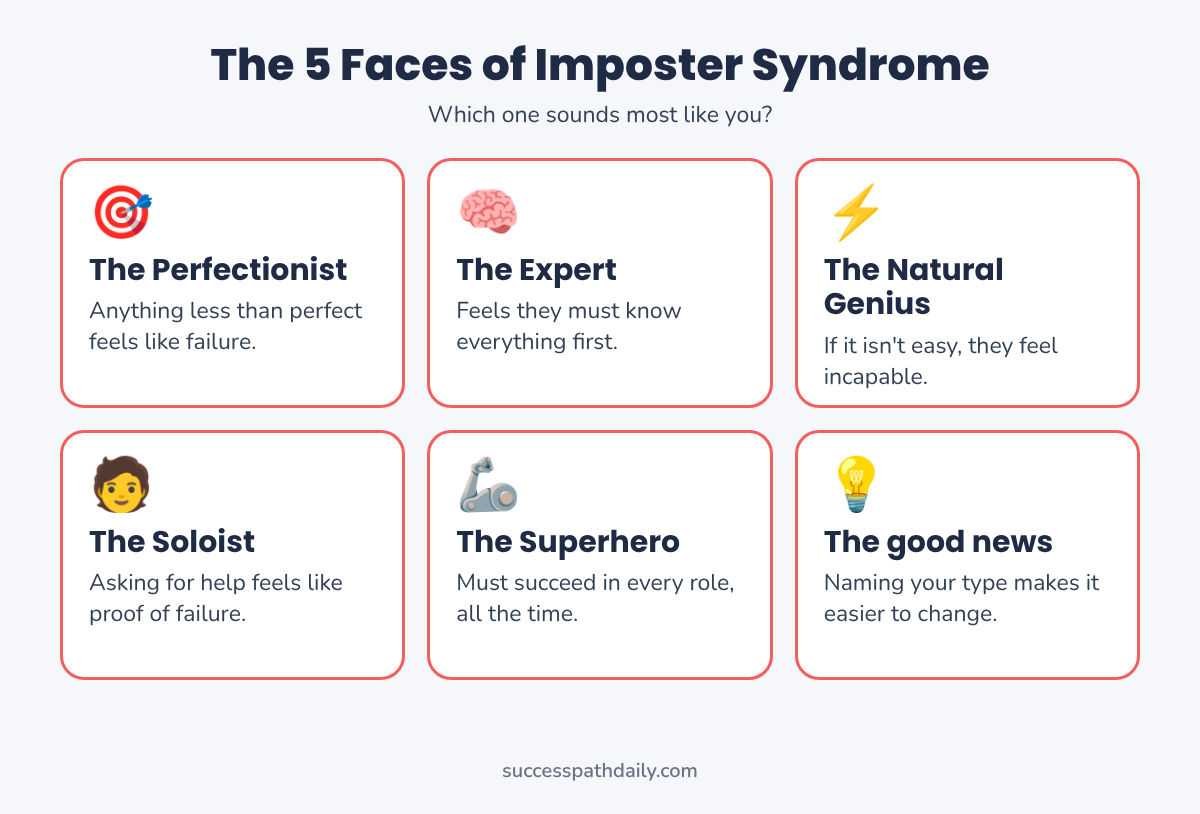
- The Perfectionist any small mistake proves you're not good enough.
- The Expert you feel you must know everything before you start.
- The Natural Genius if something takes effort, you feel you're not talented.
- The Soloist needing help feels like proof that you're a fraud.
- The Superhero you must excel in every role, at work and at home.
Why Imposter Syndrome Happens
There's rarely one cause. Common contributors include:
- Upbringing families that focused heavily on achievement, or labeled one child "the smart one".
- New roles promotions, new jobs, starting a business or going back to study.
- Being different being one of very few people like you in a room can make you feel you have to prove yourself twice over.
- Perfectionism setting standards that no human could meet.
- Comparison measuring your inside struggles against other people's polished outsides.
Comparison plays a big part. If it often makes you feel behind, our guide on how to stop comparing yourself to others can help.
9 Ways to Quiet Imposter Syndrome
1. Name the Feeling
When the thought "I'm a fraud" appears, label it: "That's imposter syndrome talking." Naming a feeling helps you step back from it instead of believing it as fact.
2. Remember You Are Not Alone
Many accomplished people, from doctors to authors to business leaders, have said they felt like imposters. The feeling is common precisely among capable people who care about doing well.
3. Separate Feelings From Facts
Feeling like a fraud is not the same as being one. Ask yourself: "What are the facts?" You were hired, promoted or chosen for real reasons: your skills, results and experience. Write them down.
4. Keep an Evidence File
Create a folder or note on your phone for thank-you emails, good feedback, finished projects and problems you solved. When doubt shows up, read it. Your brain forgets wins quickly; written evidence doesn't.
 You might also likeHow to Stop People-Pleasing: Say No Without GuiltRead it now →
5. Reframe Your Thoughts
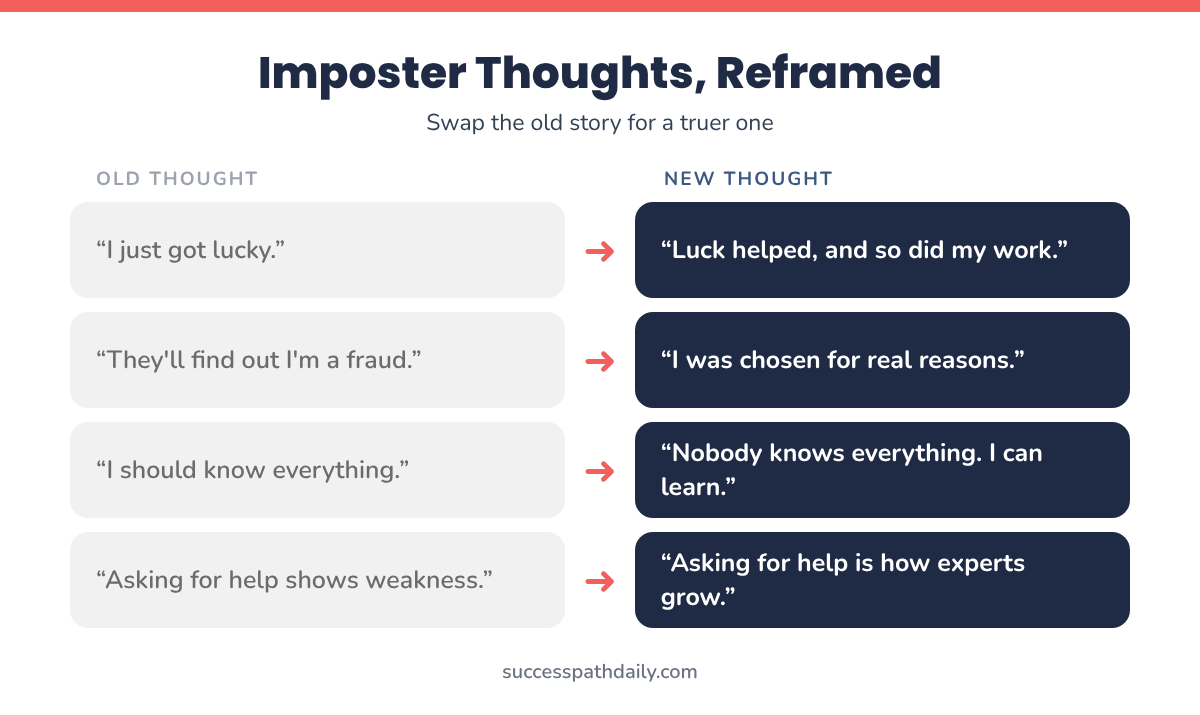
You don't have to force yourself to feel brilliant. Aim for a thought that is simply truer. "I have no idea what I'm doing" can become "I'm still learning parts of this role, like everyone who's new to it."
6. Let Go of "Perfect"
Aim for "good and finished" instead of "perfect and late". Mistakes don't prove you're a fraud; they prove you're doing real work. Every expert has a long list of errors behind them.
7. Talk About It
Share the feeling with a trusted friend, mentor or colleague. You'll often hear "Me too", and that alone can shrink the feeling. Mentors can also give you an honest outside view of your abilities.
8. Accept Praise Simply
Next time someone compliments your work, resist explaining it away. Just say "Thank you, I'm glad it helped." Letting praise land is a small but powerful habit.
9. Keep Learning, Without Waiting to Be "Ready"
Nobody feels fully ready. Confident people simply start, then learn as they go. Believing your abilities can grow with effort, a growth mindset, is one of the best long-term answers to imposter feelings.
Imposter Syndrome When You Start Something New
Imposter feelings are especially strong when you start a side project, a business or a new skill. You may think, "Who am I to do this?" The honest answer: someone who is learning, like everyone who has ever started. Our guide for people who are afraid to start a side hustle tackles this exact fear.
When to Get Extra Support
Imposter syndrome is common and usually manageable with the steps above. But if self-doubt comes with constant anxiety, low mood, trouble sleeping or feeling hopeless, please talk to a doctor or a licensed counselor. Talking therapies can help a great deal, and asking for help is a strength.
What Emily Did
Emily started an evidence file that week: her promotion email, two thank-you notes from colleagues and a list of problems she had solved that year. She also told a senior colleague how she felt. "Oh, I felt exactly the same when I started leading," he said, "for about a year."
Six months later the doubts still show up sometimes, especially before big meetings. "But now I recognize them," she says. "I read my file, I take a breath, and I go in anyway."
🌱 Free: The 10-Day Confidence Challenge. One small, brave step a day for 10 days, with a simple tracker to tick off. Free, and you can get each day's step by email.
Not sure what is holding you back most? Our free 2-minute quiz shows you, with simple first steps.
Questions People Often Ask
1. What is imposter syndrome in simple words?
It's the feeling that you don't deserve your success and that others will soon discover you're not as capable as they think, even when there is clear evidence that you are.
2. Is it "imposter" or "impostor" syndrome?
Both spellings are used and mean the same thing. The original 1978 research used "impostor phenomenon".
3. What are the 5 types of imposter syndrome?
Dr. Valerie Young describes the Perfectionist, the Expert, the Natural Genius, the Soloist and the Superhero. Many people relate to more than one.
4. Is imposter syndrome a mental illness?
No, it's not an official diagnosis. It's a common pattern of thinking. However, it can come with anxiety or low mood, and if it does, it's worth talking to a professional.
5. How do I overcome imposter syndrome at a new job?
Expect a learning period, ask questions early, keep an evidence file of wins, and talk to a mentor. Remember you were hired for real reasons.
6. Can imposter syndrome go away completely?
For many people it fades but returns at new challenges. The goal isn't to never feel it, but to recognize it quickly and keep moving forward anyway.
Final Thoughts
Feeling like a fraud doesn't mean you are one. Very often, imposter syndrome shows up precisely because you care, you're growing and you're stepping into something new.
You don't need to wait until the doubt disappears. Name it, check the facts, collect your evidence and take the next step anyway. Over time, your successes will start to feel like what they are: yours.
Sources and Further Reading
We checked the ideas in this guide against these trusted sources:
- Clance, P. R., & Imes, S. A. (1978). "The impostor phenomenon in high achieving women: Dynamics and therapeutic intervention." Psychotherapy: Theory, Research & Practice, 15(3), 241-247.
- Bravata, D. M., et al. (2020). "Prevalence, predictors, and treatment of impostor syndrome: a systematic review." Journal of General Internal Medicine, 35(4), 1252-1275.
- Young, V. (2011). The Secret Thoughts of Successful Women: Why Capable People Suffer from the Impostor Syndrome and How to Thrive in Spite of It. Crown Business.
This guide is general information, not professional or medical advice. If low mood, anxiety or self-doubt are affecting your daily life, please talk to a doctor or a licensed counselor.
💬 Did this guide help you? Leave a comment below. Your comments encourage us to keep going and write more guides like this.
🎁 Your free gift: Get our free ebook library, simple guides on money, mindset and side income. Download them right now
Read Next
✨ Your turn ✨
Which of the five types sounds most like you, and when does that feeling show up most?
Your story may help another reader who feels the same. We read and reply to every comment.
✍️ Share your storyor just tap one
💖 Thank you! Want to tell us more? Write your comment here ↓
 Next articleMorning Affirmations for Wealth and CalmKevin used to start every morning by checking bad news and his bank app. A 5-minute affirmation routine gave him calmer mornings. Here are 30 lines toRead it now →
Get the free e-books
Join our free newsletter and get instant access to all our free e-books, plus one practical tip each week.


Join the conversation
No comments yet. Be the first to share your story or your question. We reply to every comment.
Leave a comment