

Disclosure: This article contains affiliate links. If you buy through them, we may earn a commission at no extra cost to you. We only recommend products we believe may genuinely help. Read our full disclosure
⚡ Key takeaways
- Comparison is human but can quietly steal your joy.
- 10 gentle habits to stop comparing yourself.
- A 3-step reset you can use anywhere.
- 📄 Free printable: Stop Comparing: My 10-Habit Checklist
In this article
Rachel is 34 and works as a nurse in Oregon. One Sunday evening, after a long week of night shifts, she opened Instagram for "just a minute". Forty minutes later she had seen a friend's new house, an old classmate's promotion and a stranger's perfect beach holiday.
She put the phone down feeling heavy. "Everyone is moving forward except me," she thought. Nothing in her life had changed in those forty minutes. Only her mood had.
If that sounds familiar, you are not alone. In this guide we'll look at why we compare, and exactly how to stop comparing yourself to others with gentle habits that work in real life, not just on motivational posters.
(We changed the names and some details. This story is based on things many people go through.)
Why We Compare Ourselves to Others
Comparison isn't a flaw in your character. It's how human brains are built. In 1954 the psychologist Leon Festinger described what he called social comparison: when we're unsure how we're doing, we look at other people to measure ourselves.
For most of human history, that meant comparing yourself with a few dozen neighbors. Today, your phone shows you thousands of people, and mostly their best moments. Researchers have found that frequent "upward" comparisons on social media, against people who seem better off, are linked to lower self-esteem.
So the problem isn't that you compare. The problem is that you're comparing your whole, messy, real life with other people's edited highlights.
Healthy vs Unhealthy Comparison
- Healthy comparison "She learned Spanish in a year. Maybe I can learn too. Let me ask how she did it." It leaves you curious and motivated.
- Unhealthy comparison "She learned Spanish in a year. I'm useless at languages." It leaves you smaller and stuck.
The goal of this guide isn't to never notice other people. It's to move from the second kind of comparison to the first.
Signs Comparison Is Hurting You
- You often feel worse after scrolling even when nothing bad happened.
- Other people's good news stings and you feel guilty for feeling that way.
- You downplay your own wins "It's nothing, anyone could do it."
- You keep moving the goalposts whatever you achieve, someone else has more.
- You hesitate to start things because others already do them better.
If two or more of these feel true, the habits below can make a real difference.
10 Gentle Habits to Stop Comparing Yourself to Others
1. Notice It and Name It
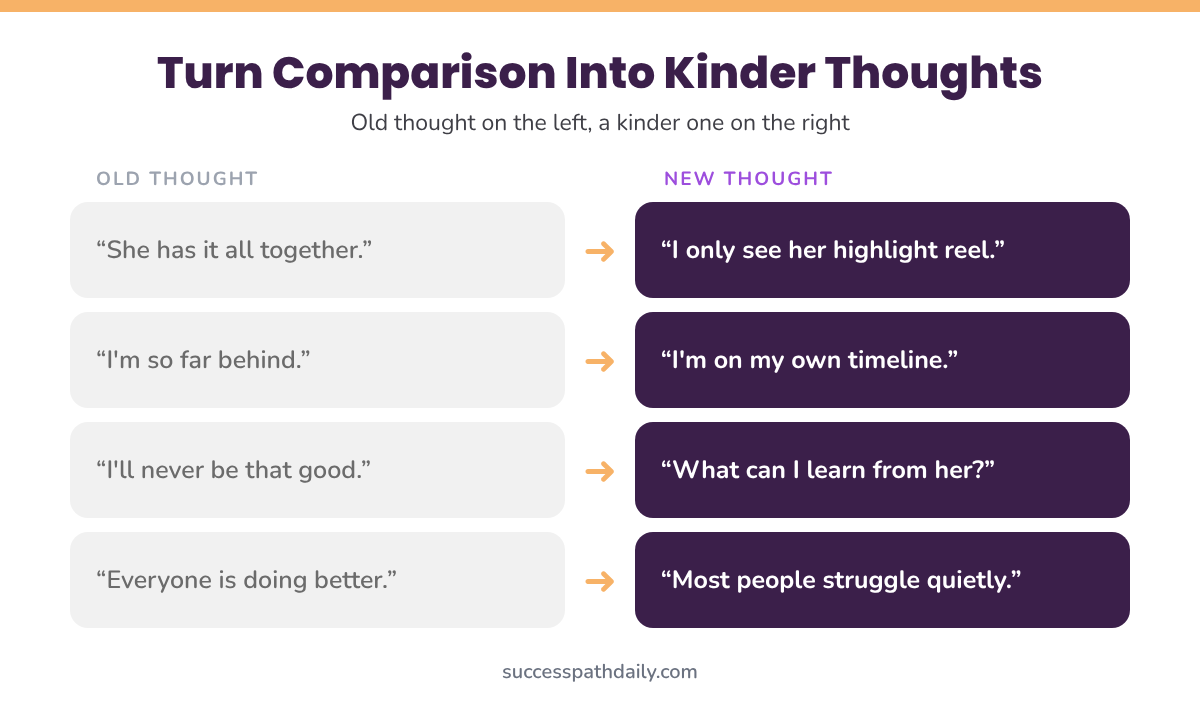
You can't change a habit you don't see. The next time you feel that little drop in your stomach, say quietly: "I'm comparing again." Naming it creates a small gap between you and the feeling, and in that gap you get to choose what to think next.
2. Remember You Are Seeing a Highlight Reel
People rarely post the argument before the family photo, the rejection emails before the promotion or the loan behind the new car. When you compare, remind yourself: "I'm seeing one chapter, not the whole book."
3. Compare With Your Past Self Instead
The only fair comparison is with who you were before. Ask yourself: "Am I a little wiser, kinder or more skilled than I was a year ago?" Most people are, and they never stop to notice.
4. Curate Your Feed
You choose who speaks to you every day. Mute or unfollow accounts that regularly leave you feeling small, even if you like the person. Follow people who teach, inspire or make you laugh. This one change often brings quick relief.
5. Set Phone-Free Times
Comparison is strongest when we're tired, bored or lonely, which is exactly when we tend to scroll. Try a simple rule: no social media in the first 30 minutes after waking or the last 30 minutes before sleep.
6. Turn Envy Into a Clue
Envy can be useful information. If you envy a friend's garden, maybe you want more time outdoors. If you envy someone's business, maybe you're ready to start something of your own. Ask: "What is this feeling telling me I want?" Then take one small step towards it.
7. Keep a "Done" List
At the end of each day, write three things you did, however small: made a healthy lunch, called your mom, finished a hard task. Over time this list becomes proof that you are moving forward, at your own pace.
 You might also likeImposter Syndrome: Why You Feel Like a Fraud and 9 Ways to Quiet ItRead it now →
8. Practice Daily Gratitude
Comparison focuses on what's missing. Gratitude focuses on what's here. Writing down three specific things you're thankful for each day gently trains your attention towards your own life.
9. Celebrate Other People Sincerely
It sounds backwards, but congratulating others helps. When you send a genuine "I'm so happy for you", you remind yourself that someone else's success doesn't take anything away from you. Life is not a race with one winner.
10. Talk to Yourself Like a Good Friend
If your best friend said "Everyone is doing better than me", you wouldn't agree. You'd remind them of everything they've done. Psychologist Kristin Neff calls this self-compassion, and her research links it with better emotional well-being. Give yourself the same kindness you give others.
Self-compassion also supports a growth mindset: believing you can keep improving, rather than being stuck where you are.
The 3-Step Comparison Reset (Use It Anywhere)
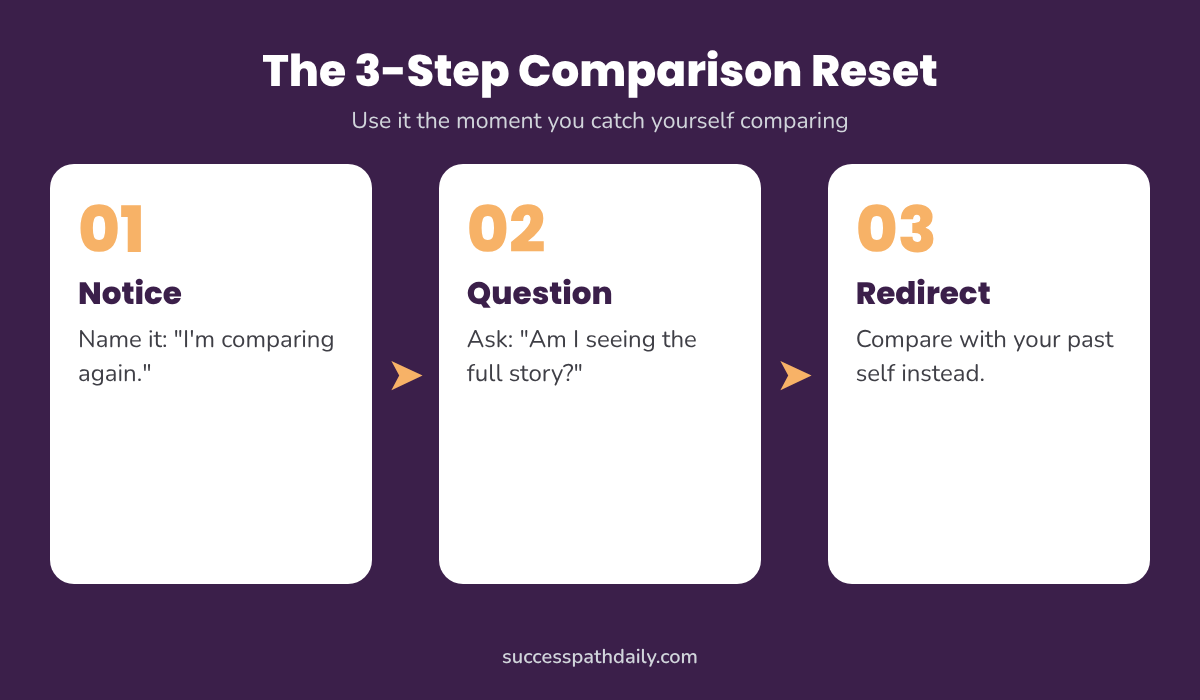
- Notice: "I'm comparing again."
- Question: "Am I seeing the full story? What don't I know about their life?"
- Redirect: "What is one thing I've done well recently? What is my next small step?"
It takes about thirty seconds, and it works at the office, at a family dinner or halfway through a scroll.
What About Comparing Money and Success?
Comparison hits hardest around money: houses, cars, holidays, salaries. Remember that you rarely see debt, stress or help from family behind the picture. Many people who look wealthy online are financially stretched.
A calmer approach is to define success for yourself. Write down what a good life looks like for you, in your own words. Then measure your progress against that, not against your neighbors. Our guide on how to change your money mindset goes deeper into this.
What Rachel Did
Rachel tried three things for a month. She muted eleven accounts that always left her feeling behind. She stopped scrolling after 9 p.m. And every night she wrote three lines in a small notebook: one thing she did well, one thing she was thankful for and one small step for tomorrow.
"The comparisons didn't vanish," she said, "but they don't run my evenings anymore. I actually noticed how much I'd done this year." She even messaged the old classmate to congratulate her, and they ended up talking for an hour about how hard the past year had been for both of them.
🌱 Free: The 10-Day Confidence Challenge. One small, brave step a day for 10 days, with a simple tracker to tick off. Free, and you can get each day's step by email.
Not sure what is holding you back most? Our free 2-minute quiz shows you, with simple first steps.

📄 Free printable
Stop Comparing: My 10-Habit Checklist
A one-page worksheet to use with this guide. Print it, fill it in and keep it where you will see it. No sign-up needed.
Download the free PDF See all printables →Questions People Often Ask
1. Why do I always compare myself to others?
Comparing is a natural human habit. Psychologists call it social comparison: we look at others to judge how we're doing. It becomes a problem when it happens all the time, especially on social media, where we mostly see other people's best moments.
2. Is comparing yourself to others ever good?
Yes, when it inspires you to learn or try something new. The key difference is how you feel afterwards: motivated and curious is healthy; small and stuck is not.
3. How do I stop comparing myself on social media?
Mute accounts that leave you feeling worse, follow people who teach or inspire you, and keep phone-free times in the morning and before bed. Remind yourself that posts are highlight reels.
4. What does "comparison is the thief of joy" mean?
The saying, often linked to Theodore Roosevelt, means that measuring your life against others can take away your happiness with what you already have.
5. How long does it take to stop comparing yourself to others?
There is no fixed time, and the habit rarely disappears completely. Many people notice a real difference within a few weeks of practicing a few of the habits in this guide every day.
6. What should I do if comparison makes me feel very low?
If comparing yourself often leaves you sad, anxious or hopeless, please talk to a doctor or a licensed counselor. You deserve support, and help is available.
Final Thoughts
You'll probably never stop noticing other people completely, and that's fine. What you can change is what happens next. Notice the comparison, remember the highlight reel, and bring your attention back to your own path and your next small step.
Learning how to stop comparing yourself to others is really learning to see your own life clearly, with kindness. Start with one habit from this guide today.
Sources and Further Reading
We checked the ideas in this guide against these trusted sources:
- Festinger, L. (1954). "A theory of social comparison processes." Human Relations, 7(2), 117-140.
- Vogel, E. A., Rose, J. P., Roberts, L. R., & Eckles, K. (2014). "Social comparison, social media, and self-esteem." Psychology of Popular Media Culture, 3(4), 206-222.
- Self-Compassion, Dr. Kristin Neff: research and free exercises on self-compassion.
This guide is general information, not professional or medical advice. If low mood, anxiety or self-doubt are affecting your daily life, please talk to a doctor or a licensed counselor.
💬 Did this guide help you? Leave a comment below. Your comments encourage us to keep going and write more guides like this.
🎁 Your free gift: Get our free ebook library, simple guides on money, mindset and side income. Download them right now
Read Next
✨ Your turn ✨
Think of the last time you felt a pang of envy. What might it be telling you that you really want?
Your story may help another reader who feels the same. We read and reply to every comment.
✍️ Share your storyor just tap one
💖 Thank you! Want to tell us more? Write your comment here ↓
 Next in this seriesHow to Stop People-Pleasing: Say No Without GuiltAlways saying yes can leave you tired and resentful. This guide explains why people-pleasing happens and gives you 8 gentle steps and kind scripts to Read it now →
Get the free e-books
Join our free newsletter and get instant access to all our free e-books, plus one practical tip each week.
Join the conversation
No comments yet. Be the first to share your story or your question. We reply to every comment.
Leave a comment