

Disclosure: This article contains affiliate links. If you buy through them, we may earn a commission at no extra cost to you. We only recommend products we believe may genuinely help. Read our full disclosure
⚡ Key takeaways
- Owner thinking focuses on problems, customers and results.
- 7 habits of people who think like owners.
- How to turn job skills into a side income.
In this article
Amanda and Lauren sat at desks right next to each other.
They had the same job. Both were office administrators at an insurance company. They had the same skills. Both were great at planning schedules, writing clear emails and fixing messy projects. They earned the same pay. And now and then, they both complained about money.
Then, over about a year and a half, something changed.
Lauren's life stayed the same. But Amanda started earning extra money on the side every month. She used the very same skills she used at work every day.
One day at lunch, Lauren finally asked. "What are you doing differently? We do the same job."
Amanda smiled. "We do the same job. But I stopped thinking about it the same way."
Then she told Lauren about one question. It wasn't about working harder. It wasn't about quitting her job. It was about learning to think like a business owner, even while being an employee.
Here is that question, and how you can start using it this week.
(Some beginners learn the practical side of freelancing from a guide called Freelancing Hacks. More about that near the end.)
(We changed the names and some details. This story is based on things many people go through. Results are different for everyone.)
Quick Check: How Do You Think About Your Job?
- When you think about earning more, is your first thought "ask for a raise"?
- Do you see your skills as "just my job"?
- Have you ever done something at work that people outside would pay for?
- Do you know what your work is worth per project, not just per hour?
If you said yes to the first two and weren't sure about the last two, you may be sitting on more earning power than you think.
Employee Thinking vs Owner Thinking

Being an employee is nothing to be ashamed of. Most people are. And most business owners started as one. But employees and owners often look at the same things in very different ways:
- An employee asks "What's my pay?" an owner asks "What problem can I solve?"
- An employee sells hours: an owner sells results.
- An employee waits for a raise: an owner looks for new customers.
- An employee sees skills as the job: an owner sees skills as a product.
- An employee says "I'll start when I'm ready" an owner says "I get ready by starting."
Notice that none of these need you to quit your job. They are ways of thinking you can practice anywhere.
The Question That Changed Amanda's Income
Here is what Amanda told Lauren.
One Monday morning, she spent two hours fixing a messy project calendar for her manager. He was so relieved that he said, "Honestly, I'd pay you myself for this."
He was joking. But Amanda couldn't stop thinking about it.
That evening, she wrote one question in her notebook:
"Who else has this problem, and would they pay to have it solved?"
That question changed everything. Amanda had always seen her skills as a job description. Now she saw them as something she could offer. Small business owners, busy consultants and local builders all had messy schedules, emails and paperwork. And unlike big companies, they didn't have an office administrator.
She started with one client, a friend's plumbing business. She helped for three hours a week, in the evenings. Then that friend told someone else. Slowly, one client became a few, all handled on weeknights and Saturday mornings.
Same skills. Same 9 to 5. One new question.
What Happened When Lauren Tried It
After that lunch, Lauren went home and tried Amanda's question. She listed ten things she did well at work. Most of them seemed boring. Writing meeting notes. Ordering supplies. Cleaning up spreadsheets.
Then she reached number eight: "Writing friendly but firm emails to customers who pay late."
She laughed. Who would pay for that?
 You might also likeHow to Make Money With Your Phone: 12 Ideas You Can Start TonightRead it now →
A week later, she mentioned it to her cousin, who ran a small cleaning company. He groaned. "I have so many unpaid bills from customers. I hate chasing people."
Lauren offered to write him a set of polite reminder emails he could use again and again. He paid her for it. And within a month, most of his late customers had paid.
Lauren still works at the insurance company. But now she has a few small clients of her own. The skill she thought was the most boring turned out to be the one people needed most.
7 Habits of People Who Think Like Owners
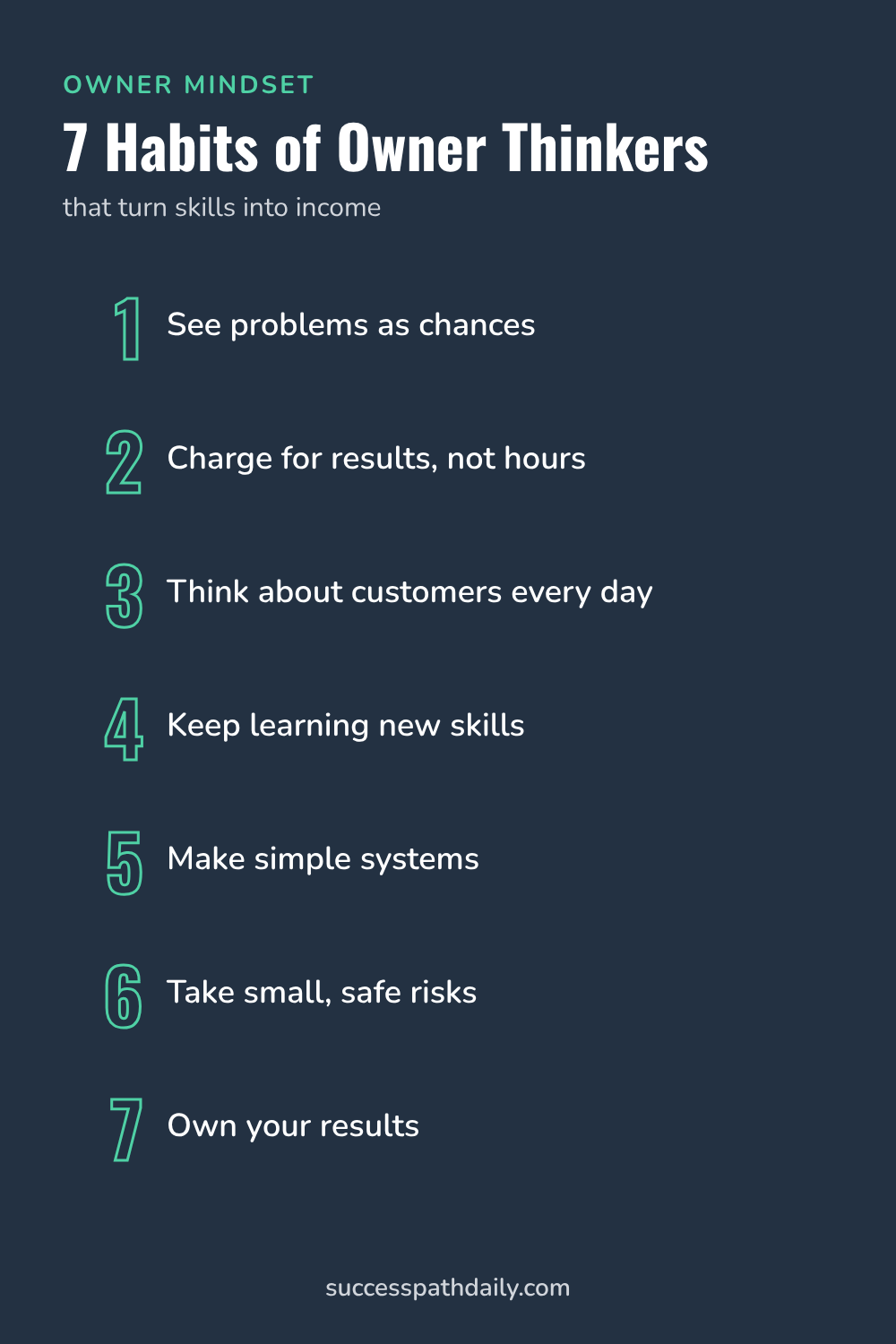
1. They See Problems as Chances
Every complaint, every "I wish someone would..." could be a business idea.
2. They Charge for Results, Not Hours
Instead of charging $20 an hour, they charge for the outcome. For example: "A clean, organized calendar for the whole month."
3. They Think About Customers Every Day
They often ask, "Who could I help, and how can I reach them?"
4. They Keep Learning New Skills
They see learning as an investment. Better skills lead to better work and better prices.
5. They Make Simple Systems
They create templates, checklists and routines. That way, work gets faster and easier over time.
6. They Take Small, Safe Risks
They test an idea with one client or one offer before putting in lots of time or money.
7. They Own Their Results
They don't wait for a boss to notice them. They choose what to work on and take charge of how it turns out.
How to Turn Your Job Skills Into Side Income
Here is a simple five-step path, based on what Amanda did:
1. List 10 things you do well at work, from writing emails to fixing spreadsheets.
2. For each one, ask: "Who else has this problem, and would they pay to solve it?"
3. Pick one skill and one type of customer to start with.
4. Offer a small, clear service to one person you know, at a fair price.
5. Ask for feedback and a referral. Then improve and repeat.
Before you start, check your work contract for any rules about side work. And keep your side business separate from your employer's time and customers.
How to Price Your First Service
Pricing is where most beginners freeze. Here is an easy way to start:
- Think about the result: what is the problem worth to the customer? Time saved? Money collected?
- Start with a small package: offer one clear thing at a set price, not an hourly rate.
- Raise your price slowly: after two or three happy customers, raise your price a little.
Your first price doesn't have to be perfect. It just has to be fair enough to get you started.
Where to Find Your First Customer
Your first customer is usually closer than you think. Start with friends, family, old coworkers and local businesses you already use.
Tell them, simply and clearly, what you can help with. One honest message often opens more doors than a fancy website.
Mistakes New Freelancers Make
- Charging too little: very low prices bring difficult customers and wear you out.
- Saying yes to everything: focus on one service you do well.
- Waiting to feel ready: your first customer will teach you more than months of planning.
- Using work time for side work: protect your day job and keep things separate.
The Tricky Part: Getting Your Offer Right
Most people who start thinking like an owner hit the same wall. They know what they can do. But they don't know how to describe it, what to charge or where to find people who will pay.
That is where many beginners get stuck. It is also where a good, practical guide can save months of guessing.
A Practical Guide to Get Started
If you want a practical guide to turning your skills into freelance income, Freelancing Hacks is worth a look. Check what is inside and decide if it fits where you are right now.
Like any guide, it does not do the work for you, and results are different for everyone.
Whatever you choose, start by asking Amanda's question about one of your skills today.
Questions We Often Get
What does it mean to think like a business owner?
It means seeing your skills as something you can offer, focusing on the problems you solve, looking for customers and taking charge of your results.
What is the difference between an employee mindset and an entrepreneur mindset?
Employees often focus on pay, hours and safety. Entrepreneurs focus on value, customers, results and new chances.
Can I start freelancing while working full time?
Yes, many people do. Start small in the evenings or on weekends. Check your work contract and keep your side work separate.
How do I turn my skills into income?
List your skills. Ask who else needs them. Pick one service and offer it to one person to start.
Do I need to quit my job to think like a business owner?
No. You can practice this way of thinking in any job. Many people build side income while keeping their job.
Same Skills, New Question
Amanda and Lauren had the same job and the same skills. The difference was one question: "Who else has this problem, and would they pay to have it solved?"
Tonight, write down three things you do well at work. Next to each one, ask Amanda's question.
One of those answers could be the start of your own small business.
Affiliate link: we may earn a commission at no extra cost to you.
💬 Did this guide help you? Leave a comment below. Your comments encourage us to keep going and write more guides like this.
🎁 Your free gift: Get our free ebook library, simple guides on money, mindset and side income. Download them right now
Read Next
✨ Your turn ✨
Has this happened to you, or is something still on your mind?
Your story may help another reader who feels the same. We read and reply to every comment.
✍️ Share your storyor just tap one
1 reader found this helpful
💖 Thank you! Want to tell us more? Write your comment here ↓
 Next in this seriesWeekend Side Hustles: 10 Ways to Earn Without Quitting Your JobEvening side hustles burn many people out. Here are 10 weekend side hustles that fit around a full-time job, plus the Weekend Batch Plan to earn more Read it now →
Get the free e-books
Join our free newsletter and get instant access to all our free e-books, plus one practical tip each week.


Join the conversation
No comments yet. Be the first to share your story or your question. We reply to every comment.
Leave a comment